

The best China journeys use each transport mode for the right distance
This guide focuses on transport in mainland China; Hong Kong and Macao use different ticketing, border, driving, and local-transport systems. Mainland China’s rail and aviation networks make major regions easier to combine, but the country’s scale still matters. A realistic journey may use an international flight, high-speed rail, a domestic flight, a private or shared road transfer, and city transport.
Rail is often strongest between connected city centers, flights can bridge very long distances, and a vehicle may be necessary for villages, trailheads, scenic roads, or places beyond the station. Compare the complete journey rather than the line drawn on a map.
Rail: the backbone of many multi-city trips

Foreign travelers can use a valid passport to buy real-name tickets through China Railway’s official 12306 English website or app, subject to identity verification. Enter names and document numbers exactly as shown in the passport, and carry the original document used for booking for station entry, exit, and onboard checks.
If an automatic gate does not read the passport, follow station signage or ask staff for the appropriate staffed channel rather than assuming the ticket is invalid. Ticket release, sales hours, change rules, refund fees, and train schedules can change; use the live 12306 listing and station announcements.
Air: useful across long distances, not every short hop
Domestic flights can make sense when rail would consume most of a day or when the route crosses distant regions. Compare airport transfer, check-in, security, baggage, possible delay, and the final drive with the rail alternative.
Use the operating airline’s current schedule and baggage terms. Keep the passport name and number consistent across every booking, and leave a buffer before an international departure when the domestic sector is weather-sensitive or infrequent.
Road travel: where planning quality matters most
Road transfers connect historic towns, rural stays, mountain valleys, grasslands, desert routes, and trailheads that rail cannot reach. They also introduce the most uncertainty: weather, traffic, checkpoints, roadworks, altitude, scenic-area controls, and daylight can turn a modest distance into a long day.
Use a licensed driver or reputable operator for demanding routes. Confirm the vehicle, seat belts, luggage capacity, pickup point, inclusions, rest stops, and who makes the safety decision if conditions worsen.
Private transfer, shared vehicle, or bus?
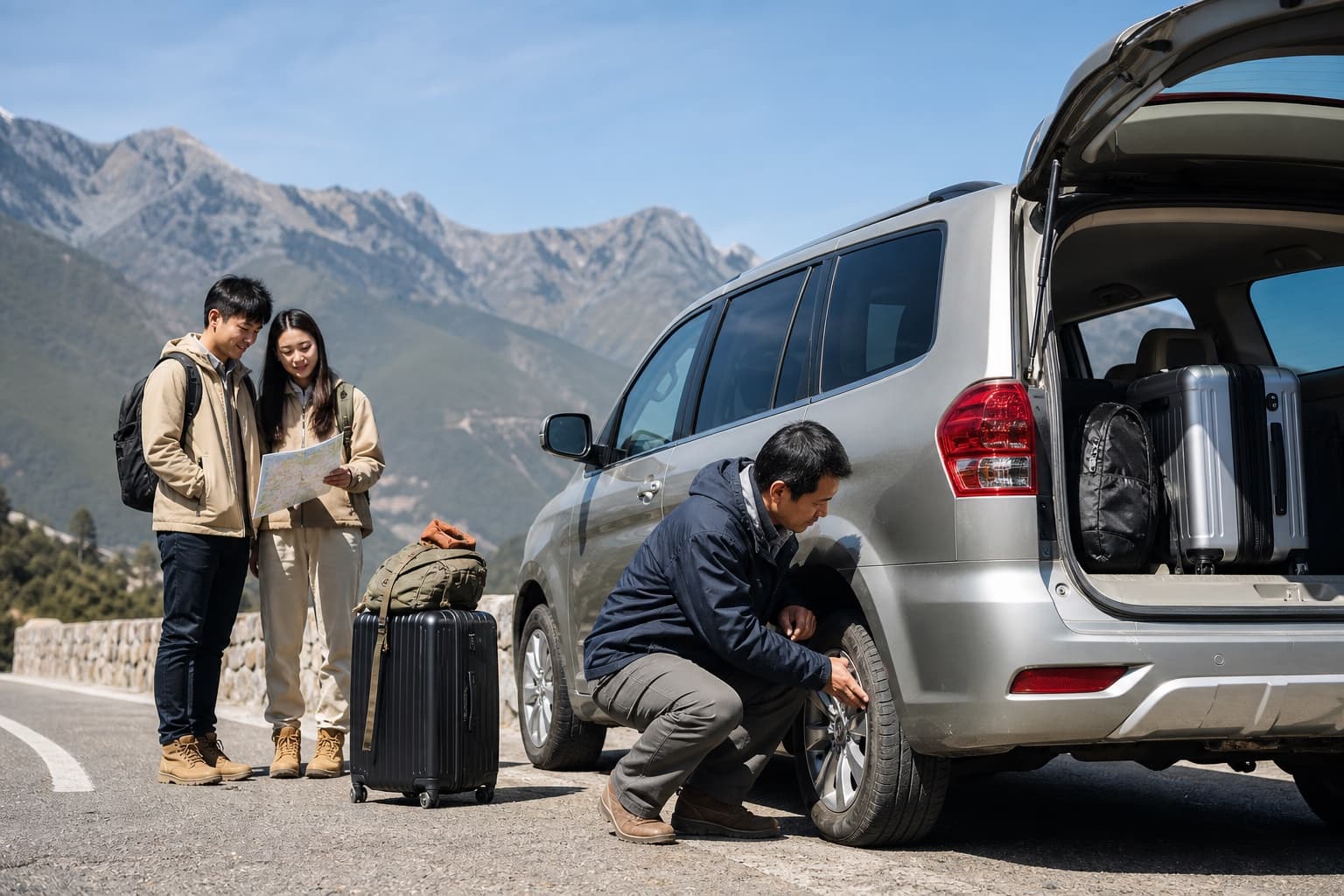
A private transfer gives control over stops, luggage, pace, and pickup, which helps families, photographers, hikers, and travelers with mobility needs. A shared vehicle can reduce cost but offers less flexibility. Long-distance buses serve many routes, though station locations, language support, and ticketing methods vary.
Confirm the exact destination and final approach. Old towns and scenic areas may restrict vehicles, while rural properties may require a walk or a smaller transfer from the drop-off point. Compare the complete service, not only the fare.
Self-driving requires Chinese authorization
Do not plan to drive on an overseas license alone. Short-term visitors generally need the Chinese provisional driving permit or license applicable to the vehicle and traveler; an International Driving Permit is not a substitute for that Chinese authorization.
The official national guide lists a passport, overseas license with Chinese translation, recent ID photographs, and any locally required documents among the application materials. Confirm the traffic-management office, processing time, rental eligibility, deposit, insurance, and vehicle class before building a self-drive itinerary.
Moving around cities and historic districts
Urban transport differs by city and may include metro, bus, taxi, ride-hailing, ferry, cycling, and walking. Payment methods and app support vary. Save the destination’s Chinese name, full address, phone number, and correct entrance rather than relying only on an English transliteration.
Historic quarters can include pedestrian lanes, steps, stone paving, vehicle restrictions, and crowded access points. Ask the property for the best drop-off point and walking distance before arrival.
Make every transfer easier
Keep the original passport used for tickets in hand luggage
Save Chinese names and addresses for stations, hotels, and meeting points
Allow time for identity checks and large stations
Use luggage that can manage stairs, old lanes, and smaller vehicles
Carry water, layers, power, and essential medicine on long road days
Protect the final international connection with a buffer
Agree on pickup, vehicle, inclusions, and emergency contact in writing
Cross-border trains and buses need a separate check
An international rail or bus segment involves immigration documents, permitted ports, ticket rules, baggage, and onward-entry requirements that do not apply to a domestic journey. The China–Laos Railway and rail links with Hong Kong are examples where the exact sector and border process matter.
Check the entry conditions for every country or region in the route and use the official operator or an authorized seller. Build extra time around the international segment and do not assume a domestic platform displays the full procedure.