
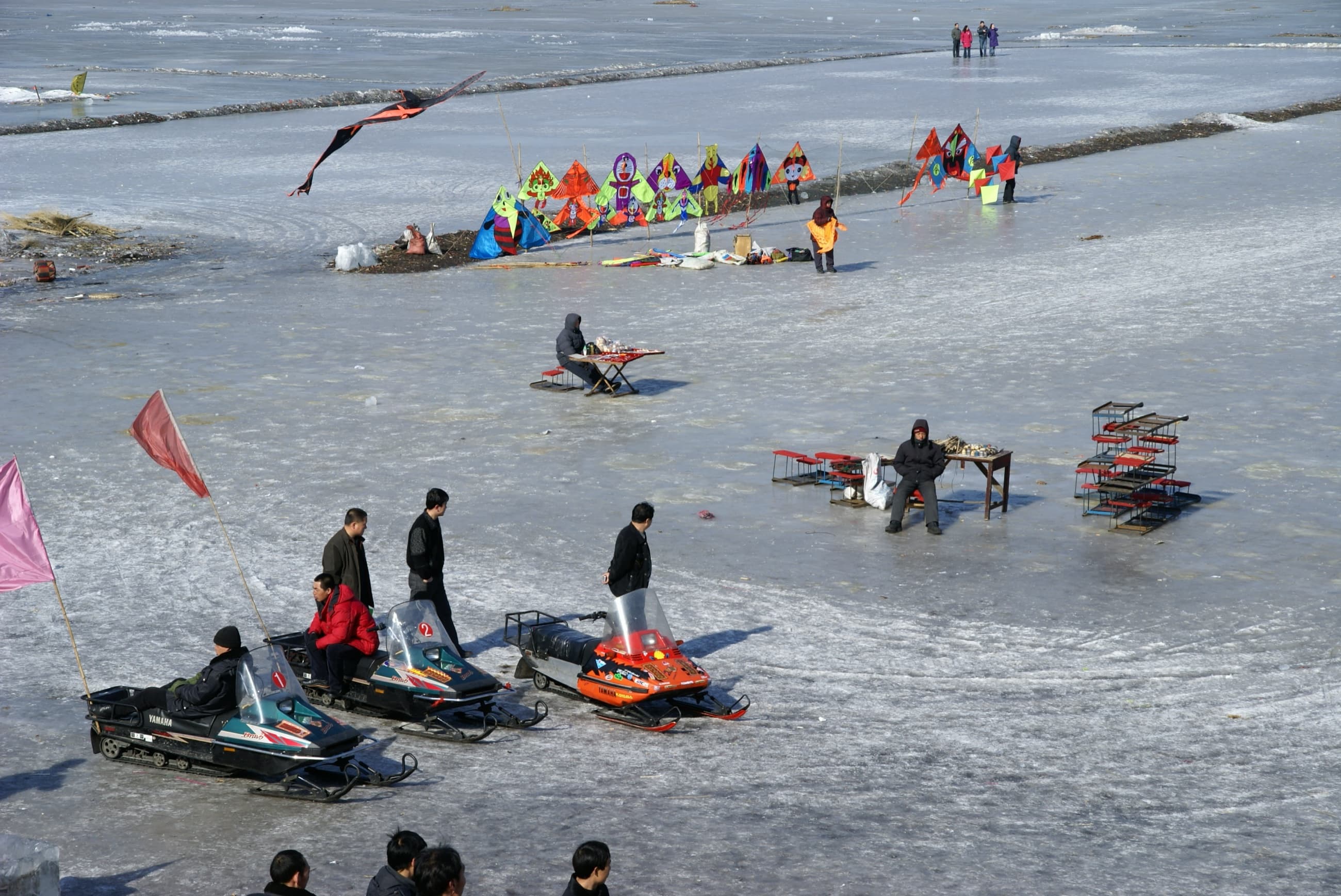
Before the towers, there is a frozen river. Snow flattens the Songhua’s banks, the air sharpens and the water that defines Harbin in summer becomes a working surface. The temporary city called Harbin Ice-Snow World begins here — not with coloured lights, but with people reading ice.
They look for thickness, clarity and consistency. Snow and rough surface ice are cleared. Lines are set across the river and cut into regular blocks. A crack, trapped sediment or clouded layer may disqualify a block before it reaches the construction site.
At night, visitors will see palaces and towers glowing blue, gold and violet. On the river, the material is almost colourless. The first transformation is an act of selection: deciding which part of the winter landscape can become architecture.
Cutting the First Block
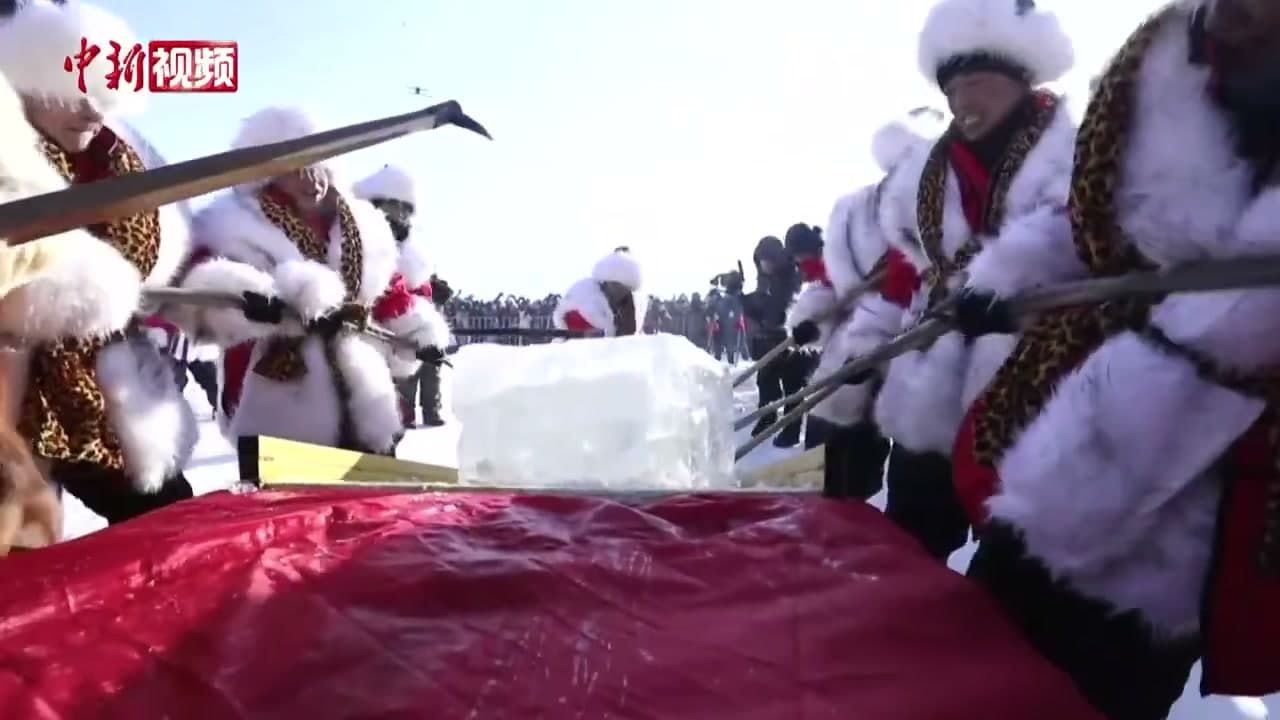
Ice harvesting is partly industrial and partly ceremonial. Saws and machines divide the surface, but hand tools still guide, separate and manoeuvre blocks. Teams work in severe cold as ice plates are cut free, raised from the water and moved toward waiting vehicles. A material that looks immovable becomes a supply line.
Harbin also marks the season with an Ice Harvest Festival. The ‘first ice’ becomes an auspicious beginning accompanied by flags, drums and public ritual. Ceremony does not replace the labour that follows; it makes the relationship among river, risk and livelihood visible.
The spectacle seen by visitors rests on a second choreography — clearing, measuring, cutting, hauling and checking, repeated block after block.
From an Ice Shell to an Ice City
Local accounts trace Harbin’s ice-light tradition to a simple device: water frozen around the inside of a bucket to form a hollow shell, with a light placed inside. Harbin held its first ice-lantern fair in Zhaolin Park in 1963. Ice-Snow World opened in 1999, enlarging the idea into an environment of walls, routes, slides and monumental forms.
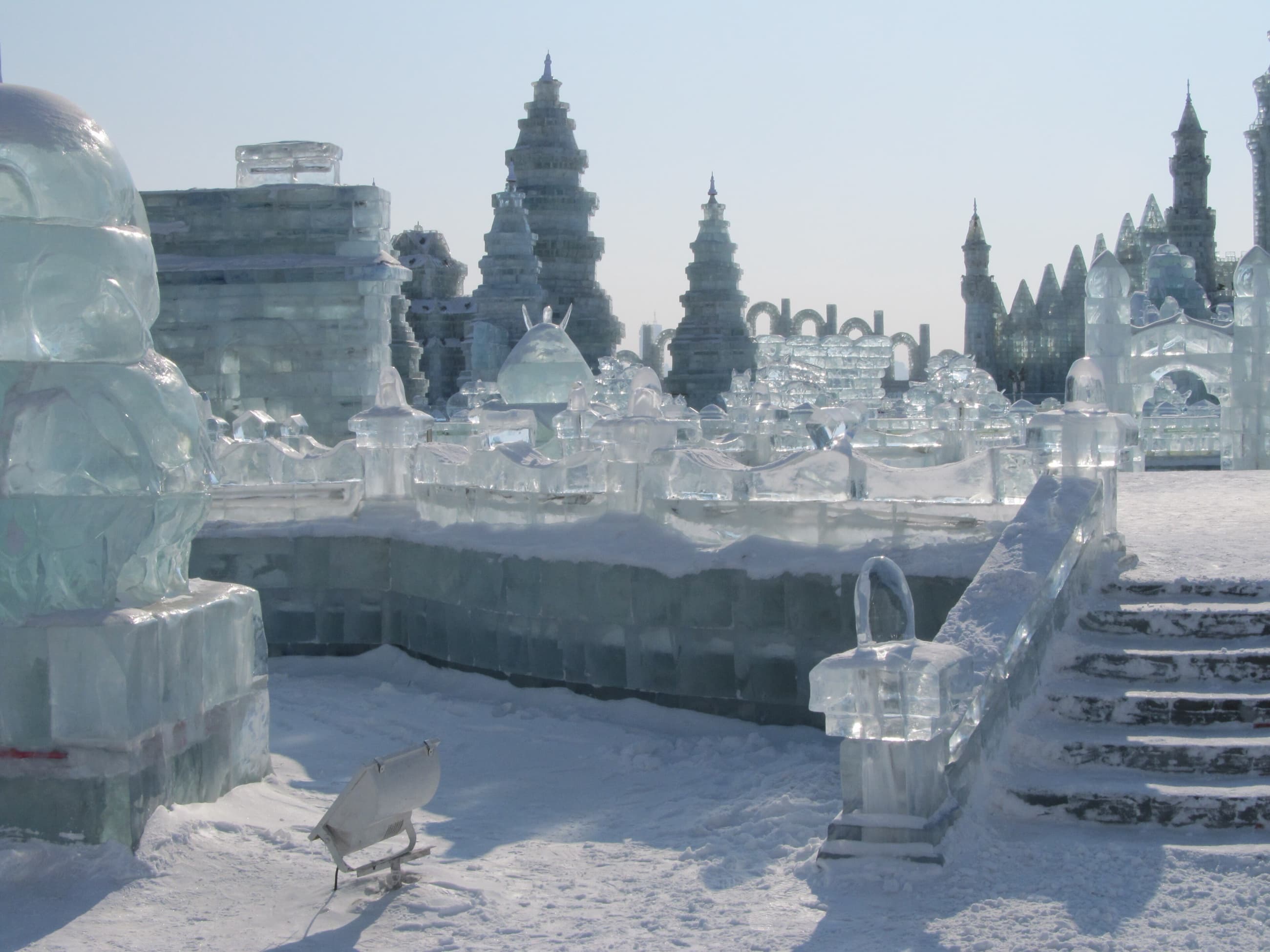
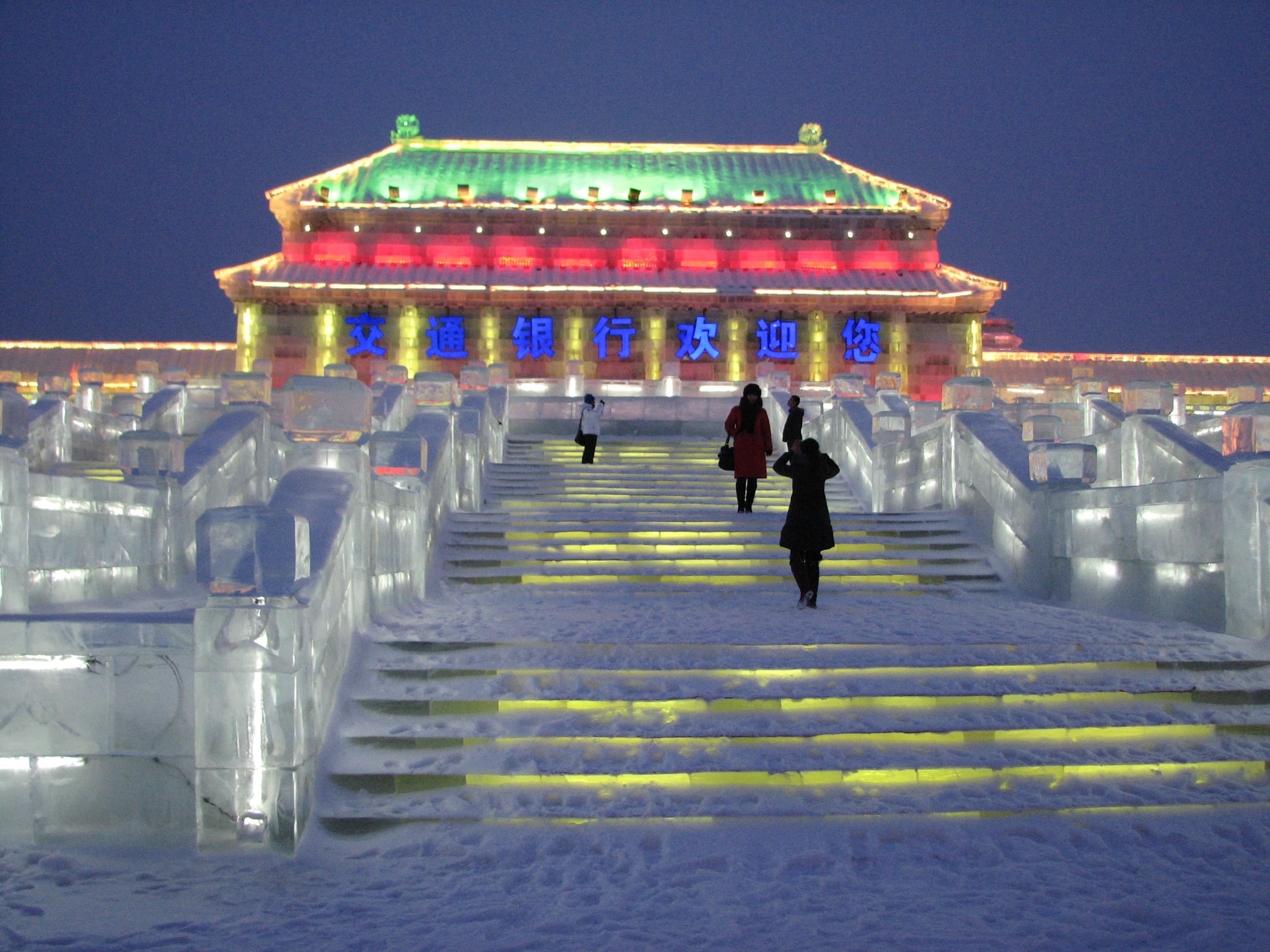
In daylight, construction logic is easier to read. Blocks sit in courses. Joints, steps and repeated units reveal that the fantasy city is also masonry — except its brick was cut from a river and its working temperature must remain below freezing.
Image: daylight scene from the 2013 festival. Tracy Hunter / Wikimedia Commons, CC BY 2.0; resized for web.
Building at the Speed of Weather
A permanent city can extend a project or wait through a season. An ice city works inside a narrower window. The river must freeze, material must become available, thousands of elements must be assembled, and the park must open while winter is reliable. Weather is the project calendar.
The 26th edition, opened in December 2024, makes the scale concrete. Official reporting described a one-million-square-metre park built with 300,000 cubic metres of ice and snow. More than 10,000 workers and nearly 1,000 units of machinery were expected to participate. These figures belong to that edition, not a fixed annual standard.
Some early construction blocks had been stored from the previous winter beneath insulating layers. A park that appears in a few December weeks may have begun a year earlier.
Never the Same Skyline Twice
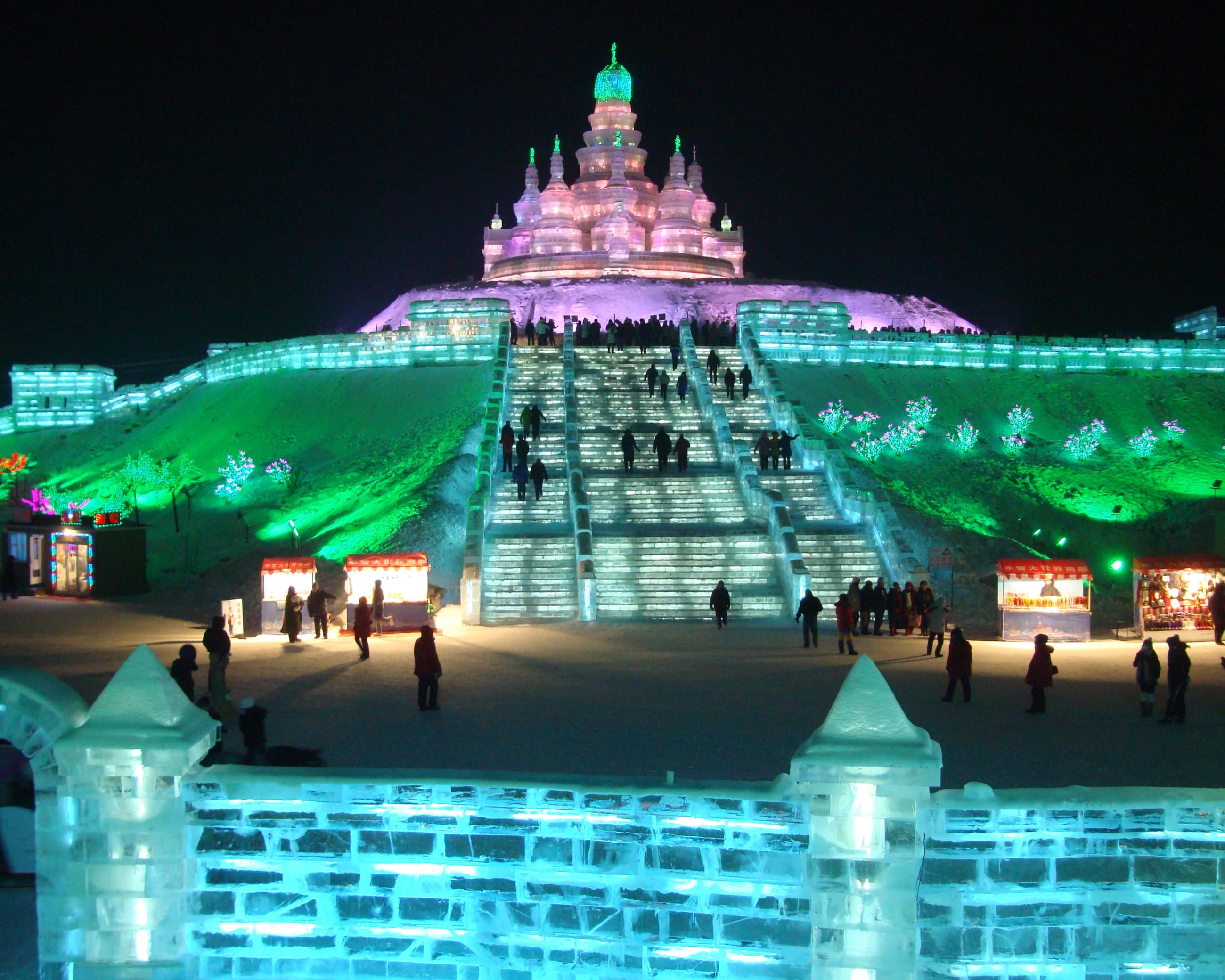
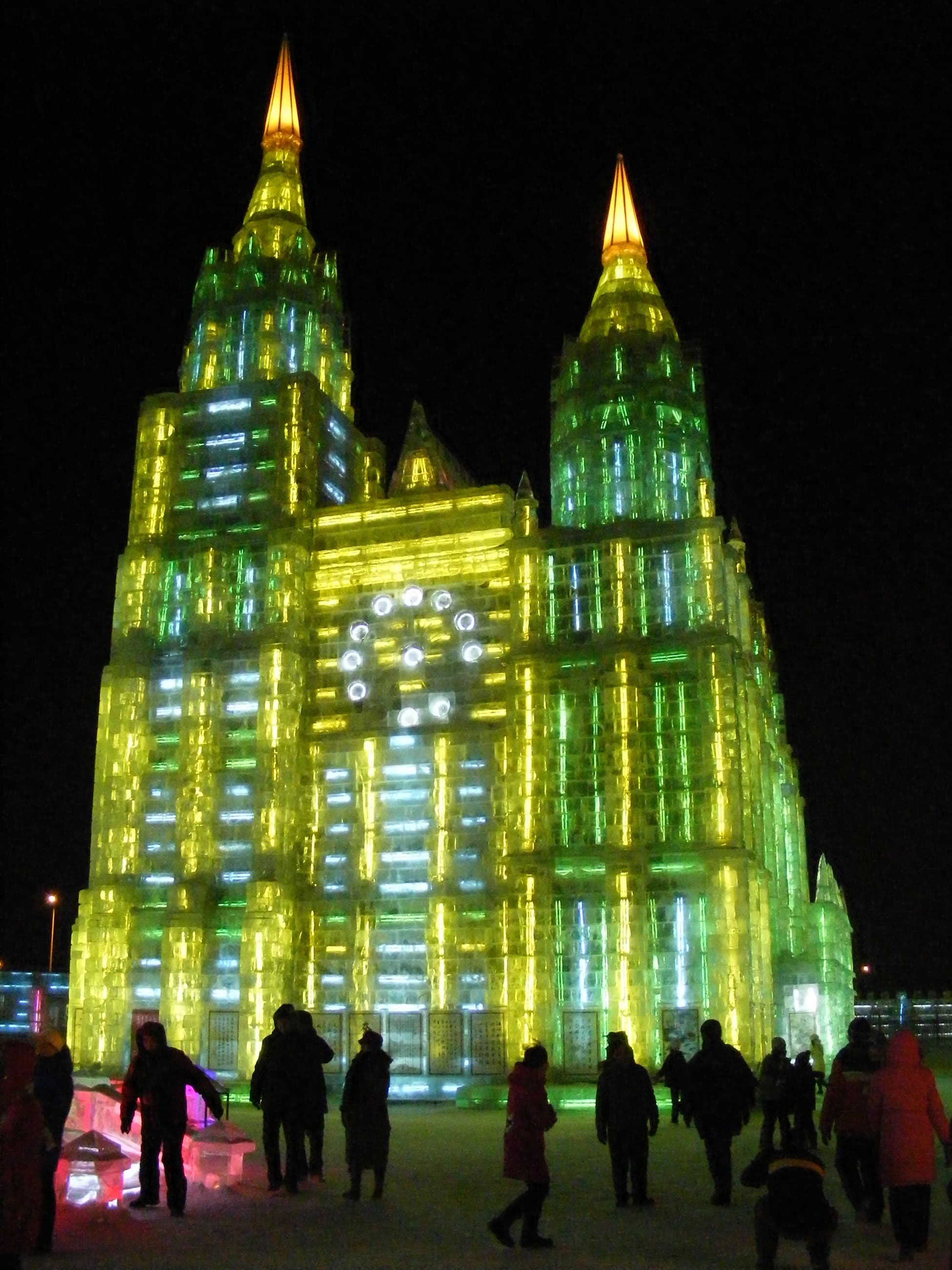
The structures borrow visual languages from towers, gates, bridges, temples, imagined castles and contemporary event symbols. Each edition is a new composition shaped by its theme, space, engineering decisions and the behaviour of the material.
Because last winter’s skyline cannot simply be maintained, design knowledge survives differently. Drawings, methods and experienced teams continue; the physical architecture does not. Harbin preserves the ability to make an ice city rather than any single ice city itself.
The City Needs Its Crowd
At human height, monumental ice becomes tactile. Visitors walk beside blocks large enough to read individually, queue below towers and move through coloured light. Coats, breath and careful footsteps are part of the visual field.
The crowd is also part of the park’s economics. The 26th edition operated for 68 days, from 21 December 2024 to 26 February 2025, and its operator reported 3.56 million tourist visits. Those numbers belong to a record season, not every winter, but they show how a temporary landscape can organise travel, work and public life across a city.
Cold becomes material; darkness becomes an advantage for illumination; winter labour becomes a specialised industry. This does not make the cold harmless. It means Harbin has learned to design with it.
Ice Is Not Snow
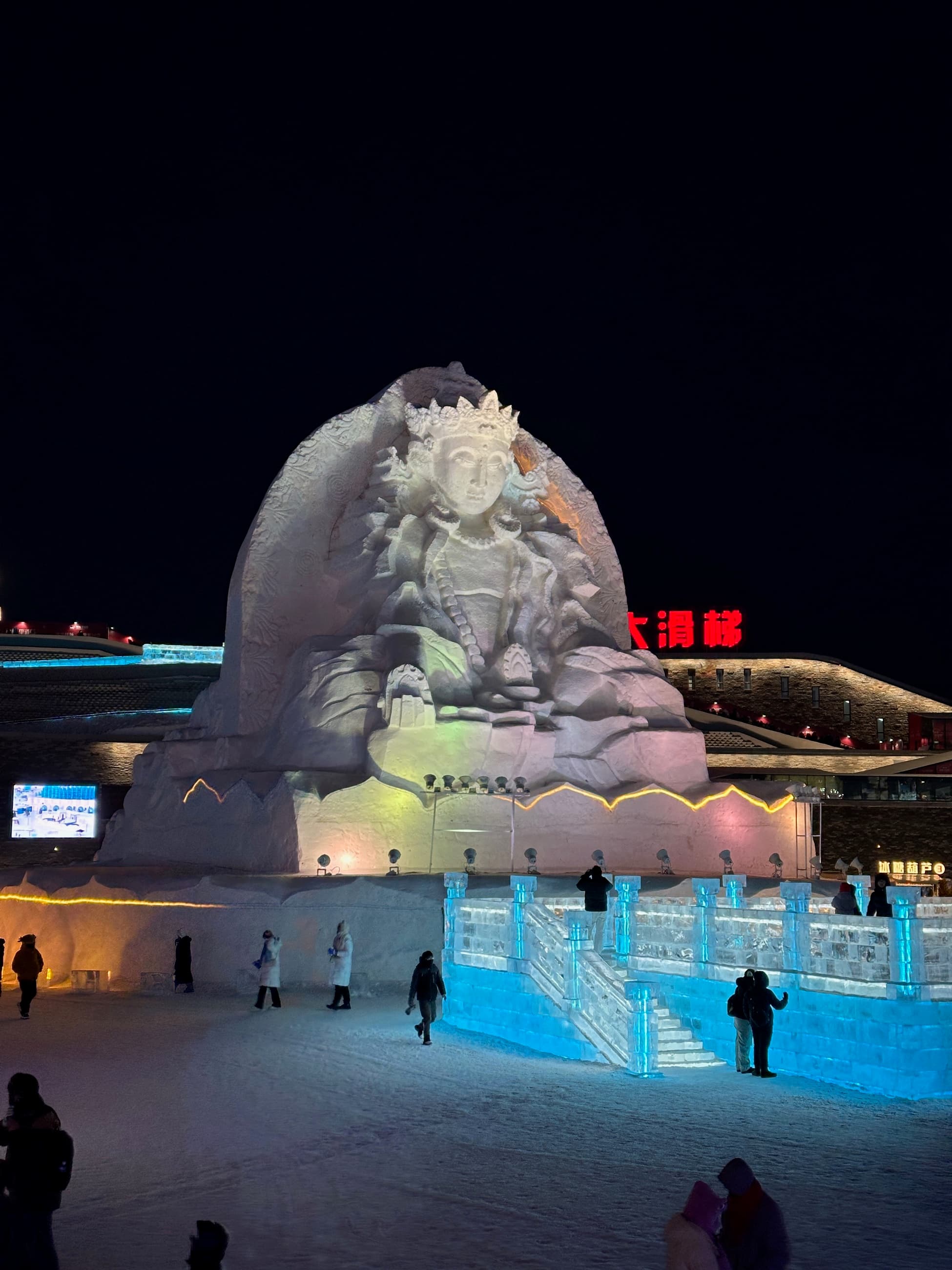
Clear river ice can be cut into blocks and lit through its mass. Snow is compacted and carved, producing opaque surfaces that hold shadow rather than transmit colour. One builds luminous walls; the other models faces, fabric, animals and relief.
Putting both in one park makes winter legible in contrasting forms: water frozen dense enough to build, and snow compressed enough to carve. The city is not one technique enlarged. It is a collaboration among architecture, sculpture, lighting, machinery and climate.
Image: snow sculpture at the 2026 festival. Garosio33 / Wikimedia Commons, CC0; resized for web.
Designed to Disappear
When temperatures rise, the luminous streets do not become permanent real estate. After closing, the park is dismantled and the site cleared; remaining ice and snow then disappear with the season. The physical city has reached the end built into its design. That disappearance is not a conservation failure but a condition of the project.
The blocks will not endure like stone, but skills return: how to judge river ice, move it safely, stack it, carve it and light it. The next skyline will differ, yet it depends on knowledge carried across winters. A tradition can remain continuous while every major object it produces is temporary.
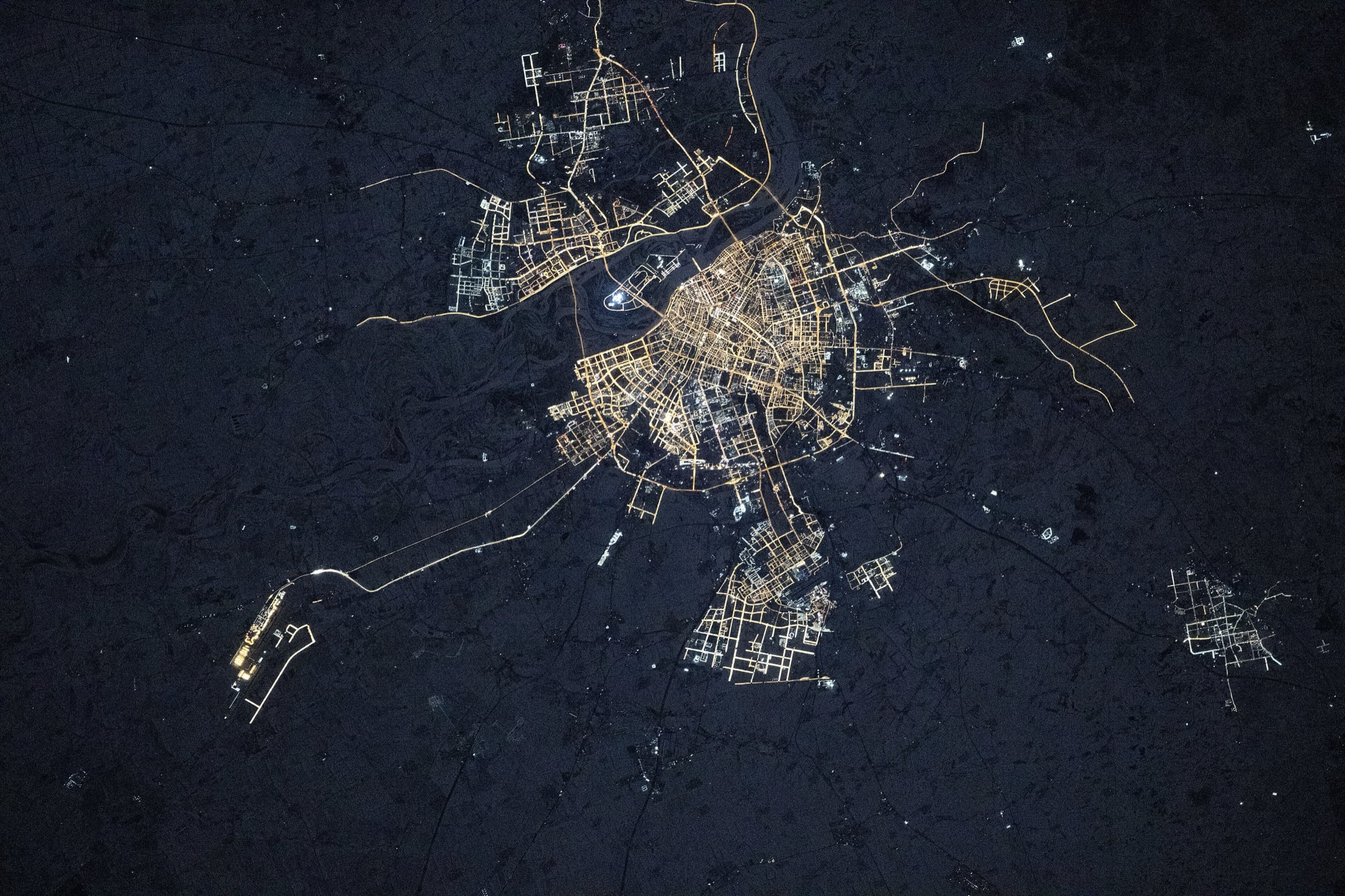
Seen from orbit, Harbin is far larger than the seasonal park. Ice-Snow World does not define all of Harbin, but it makes one fact visible: winter here is not empty time. River ice becomes architecture; the architecture is deliberately removed; the knowledge is carried into another winter. What stays is the decision to build again.
Image: Harbin from the International Space Station, 2026. NASA Johnson Space Center / JAXA astronaut Kimiya Yui, Public Domain; resized for web.