
Where the Figure Comes Alive
Before the light is turned on, the puppet can look like an intricate but motionless cutout. Hold it close and the detail is astonishing: a face opened in tiny lines, clothing made from repeated curves, joints linked so that an arm can rise. Then the performer brings it against a lit screen. Colour, outline and movement suddenly belong to a character rather than an object.
Chinese shadow puppetry has many regional traditions. Shaanxi is one place where carved figures and stories have been particularly celebrated. The essential theatrical arrangement is disarmingly economical: translucent figures, rods, light, screen, voices and music. What appears on the audience's side may be a procession, a confrontation or a romance. On the other side are people working at close range with materials that can fit into a case.
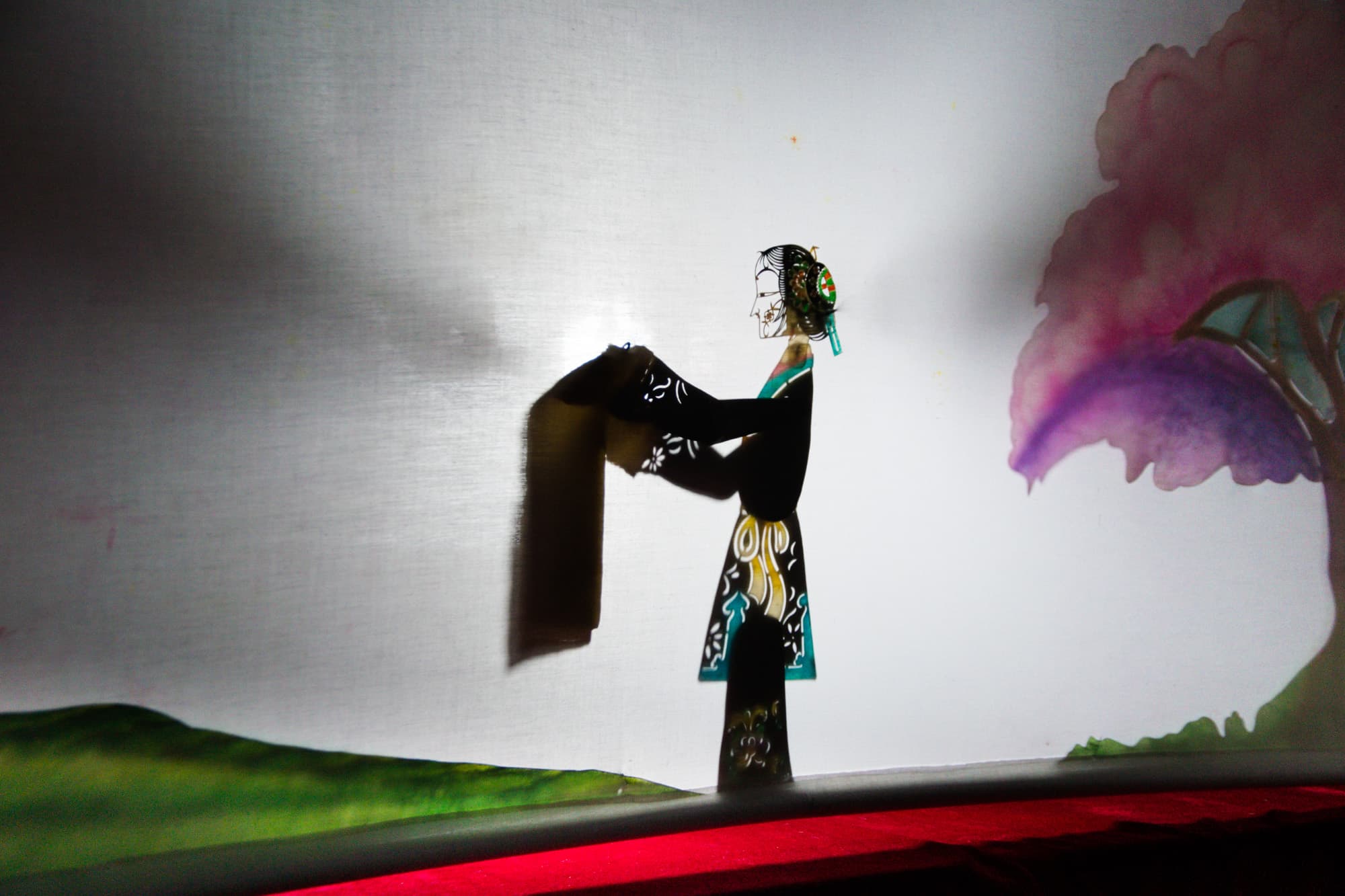
The Audience Sees Only Half
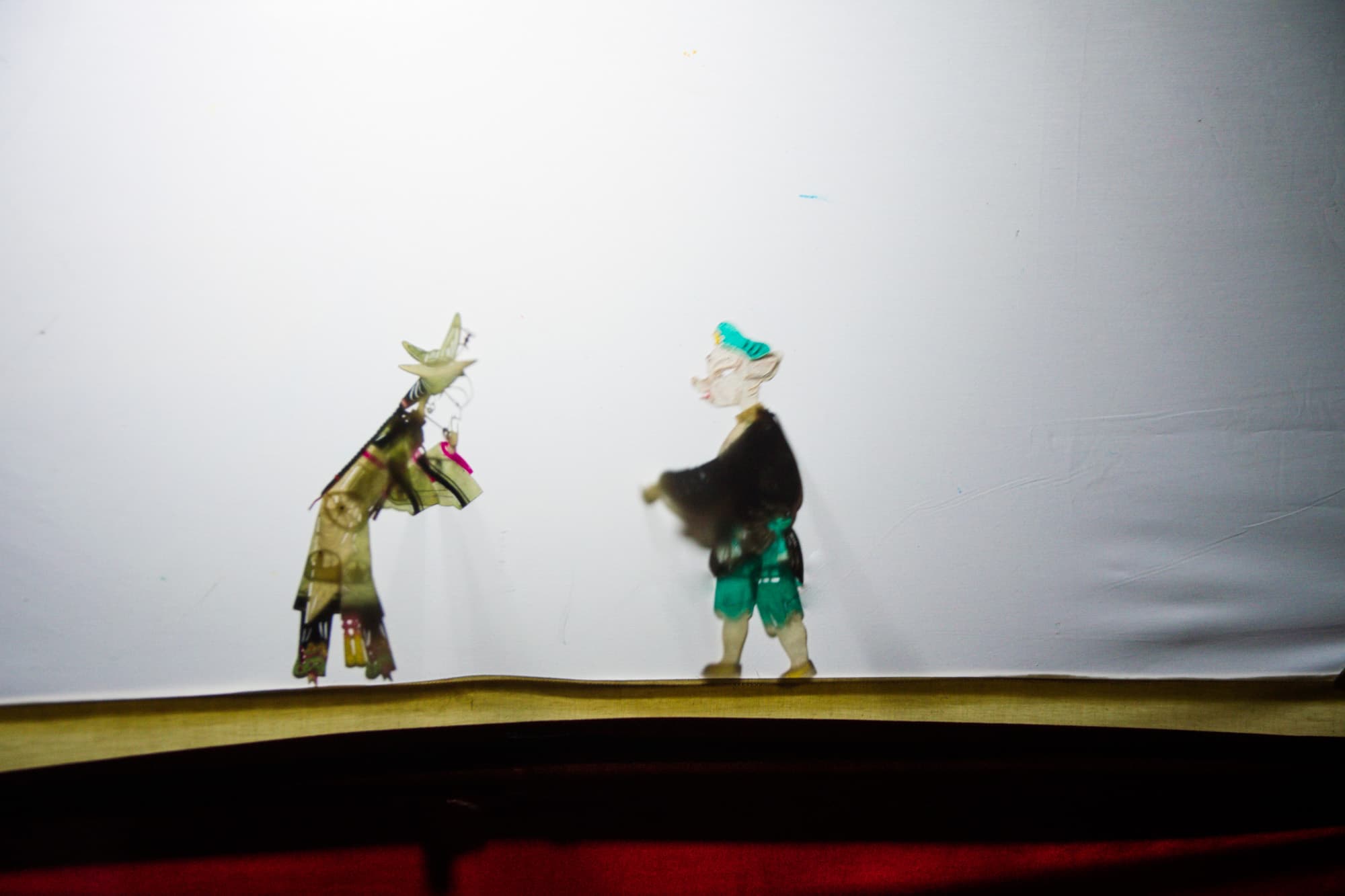
A shadow play has two stages at once. In front of the screen, figures move with an apparent freedom. Behind it, a performer adjusts several rods, coordinates with singers or musicians and keeps characters aligned with the light. A well-timed turn can make a flat puppet seem to look back at another. The illusion depends on the audience not seeing every practical decision.
UNESCO describes a national tradition in which figures may be made from leather or paper, articulated and controlled with rods while stories are voiced and accompanied by music. That description identifies shared features, not a rule that every Shaanxi troupe uses the same number of joints or plays in precisely the same way. Regional variation is part of the art's vitality.
Cutting Light from Leather
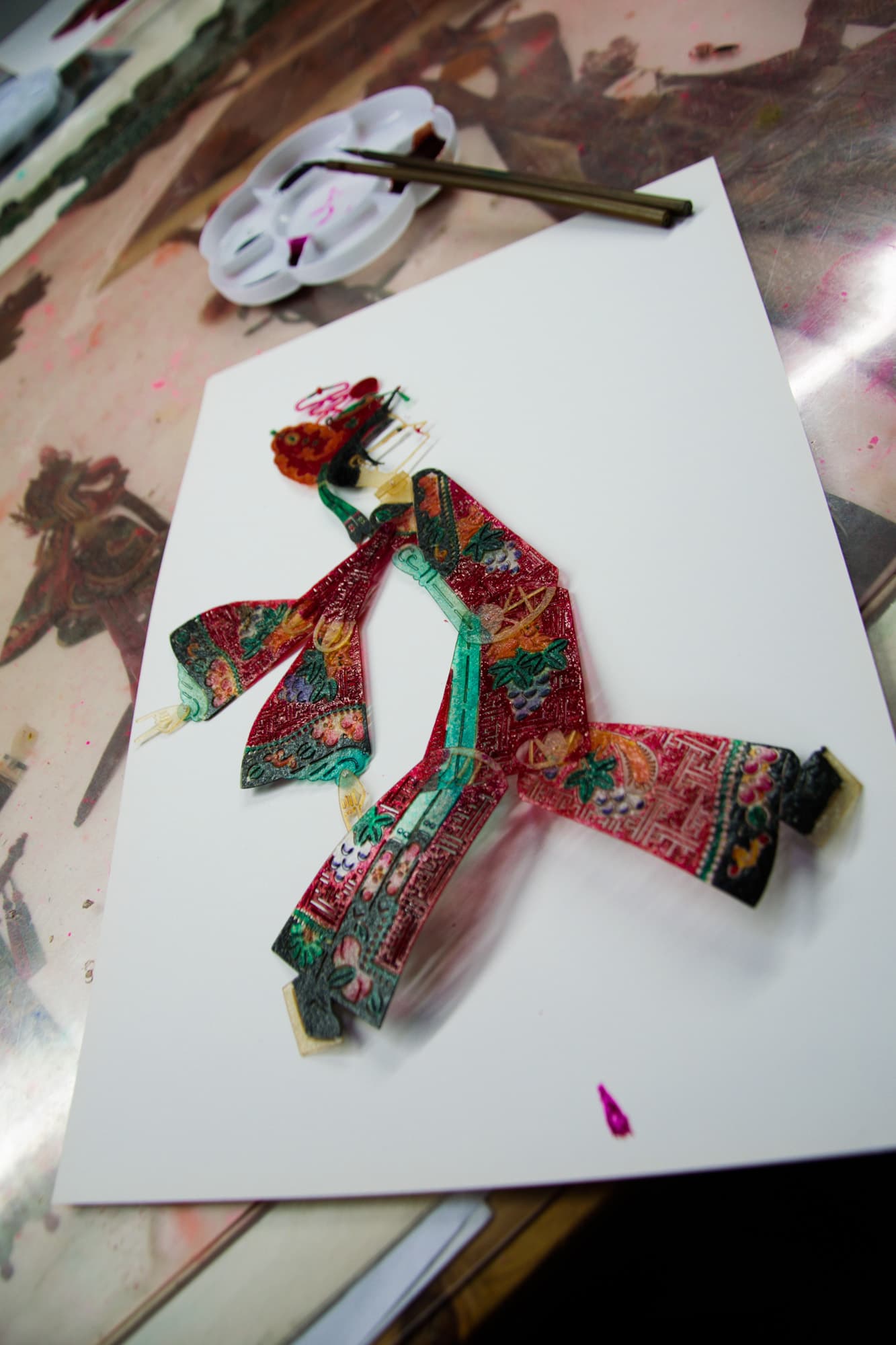
The maker's task is not simply to paint a silhouette. Openings cut into the figure determine where light will pass; dyed surfaces can add colour on the screen; movable sections make gesture possible. The puppet has to survive handling while remaining light enough to animate. Its construction is both visual design and stage engineering.
An isolated museum piece can be read like a miniature artwork. Yet its shape was designed for distance, illumination and motion. A face that seems stylised close up may become immediately legible when projected. A joint hidden by a costume line may supply the movement that carries a scene. The craft's achievement lies in keeping both scales in mind: the small object and the large story it will cast.
A Historical Figure, Not a Live Cast
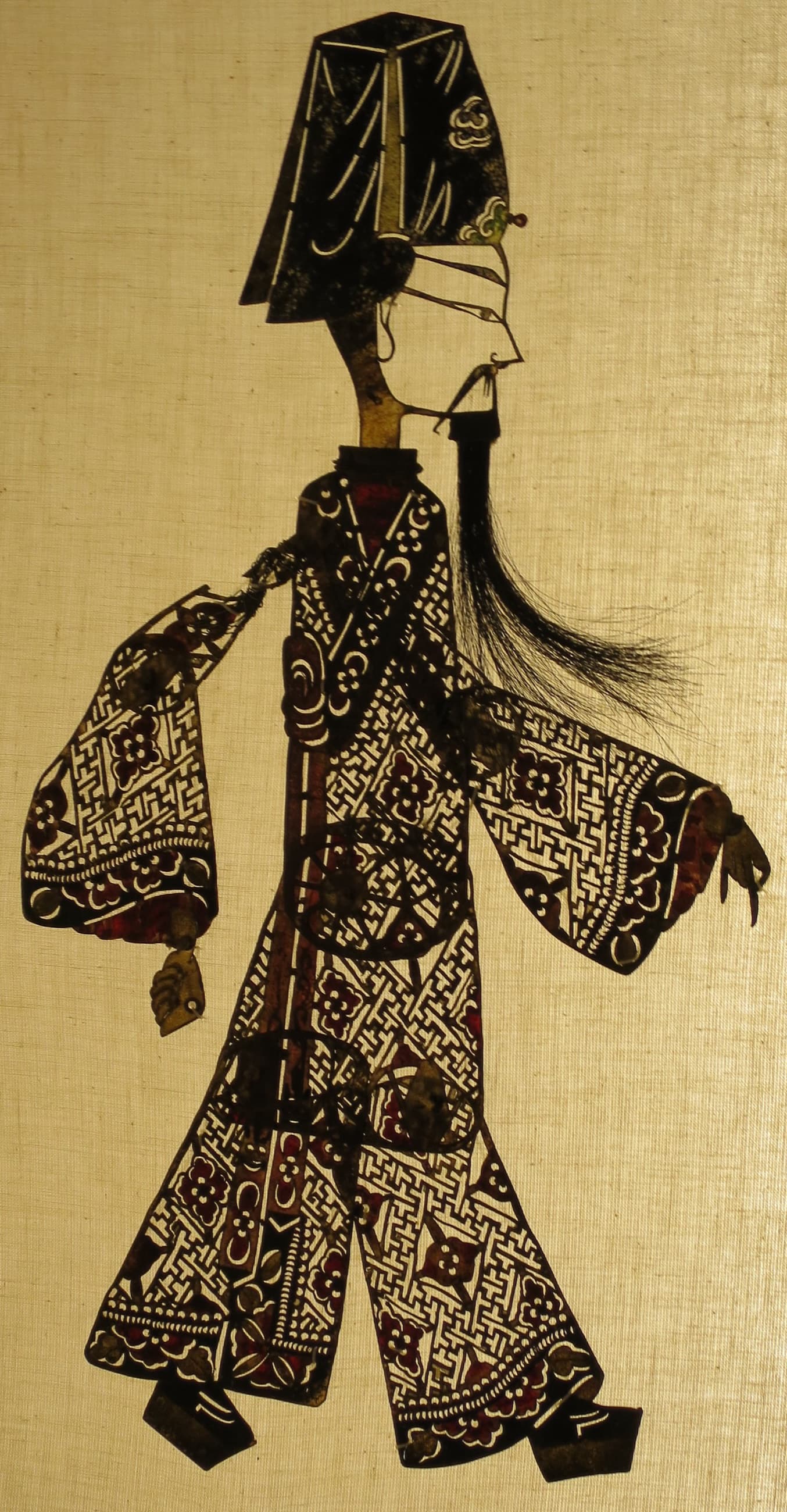
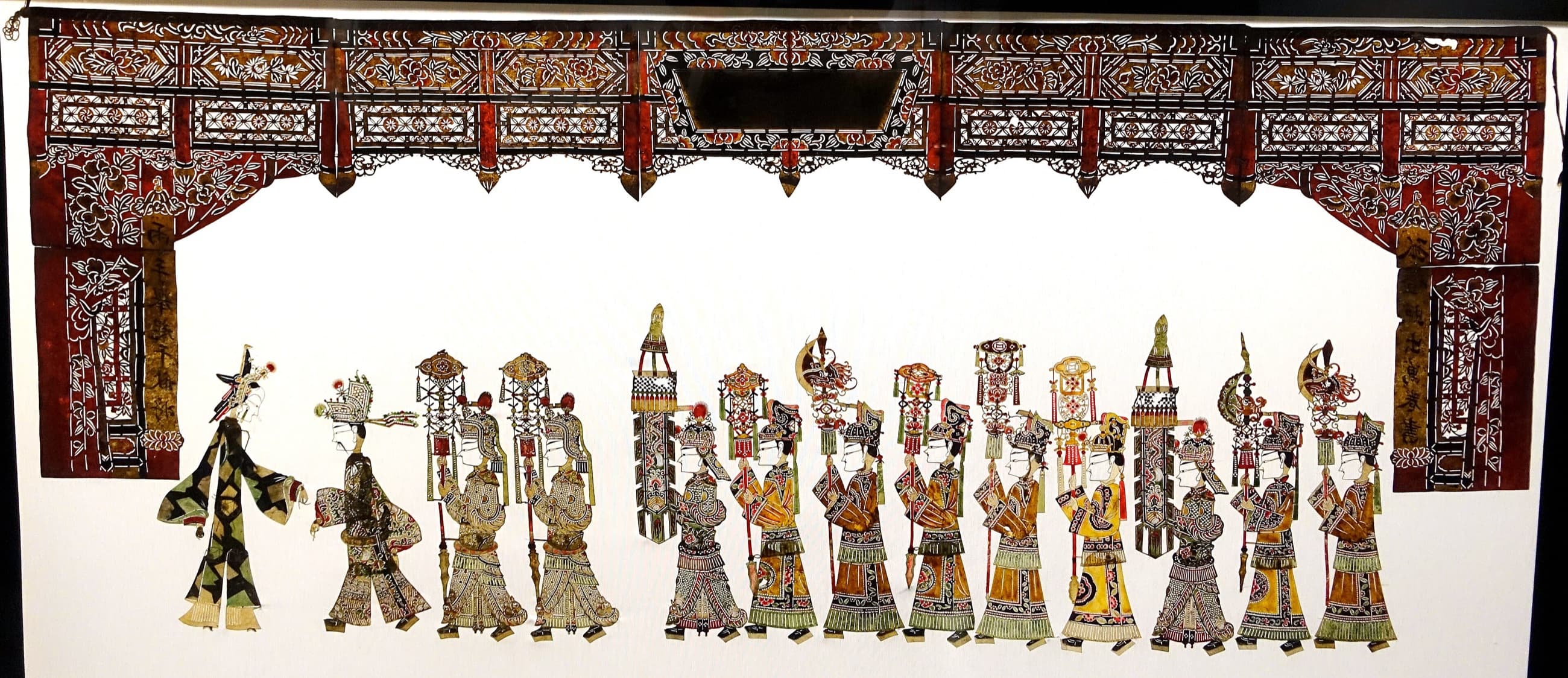
This nineteenth-century puppet from Shaanxi is preserved in a museum collection. Its survival lets us study design and material choices, but it does not tell us how every contemporary troupe works. A displayed character is a source, not a complete performance.
Look at the figure as an object meant to change under light. The fine openings and jointed parts are invitations to motion. The screen would have hidden the hands that made those movements; the museum removes the screen and lets us see the work behind the illusion.
Image: Hiart / Wikimedia Commons, CC0; resized for web.
A Story Can Change Its Scale
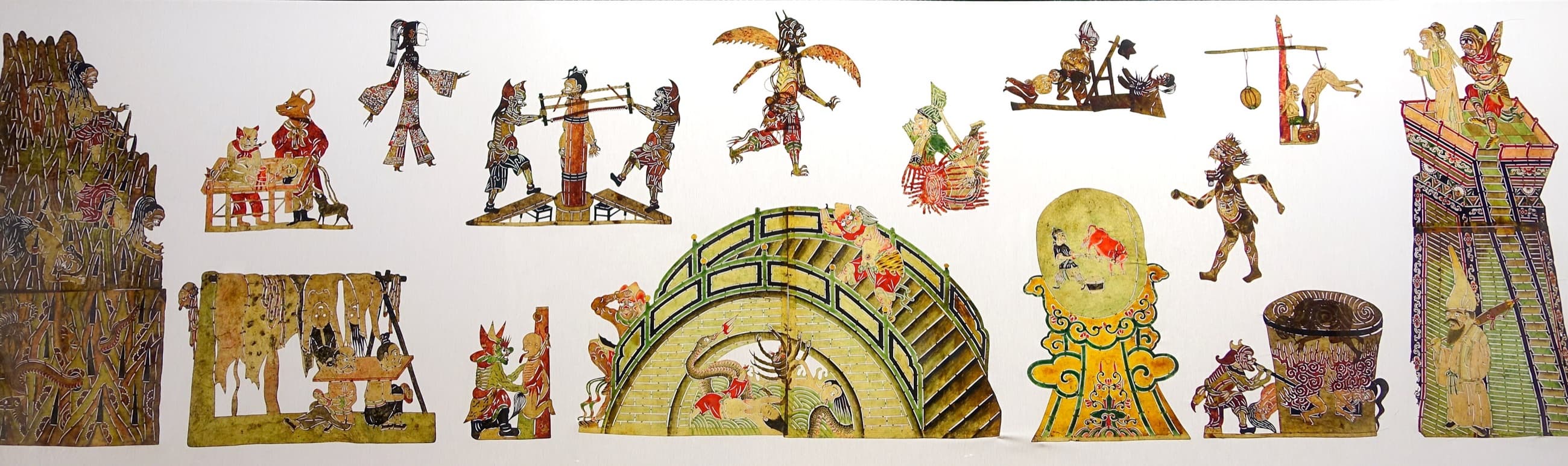
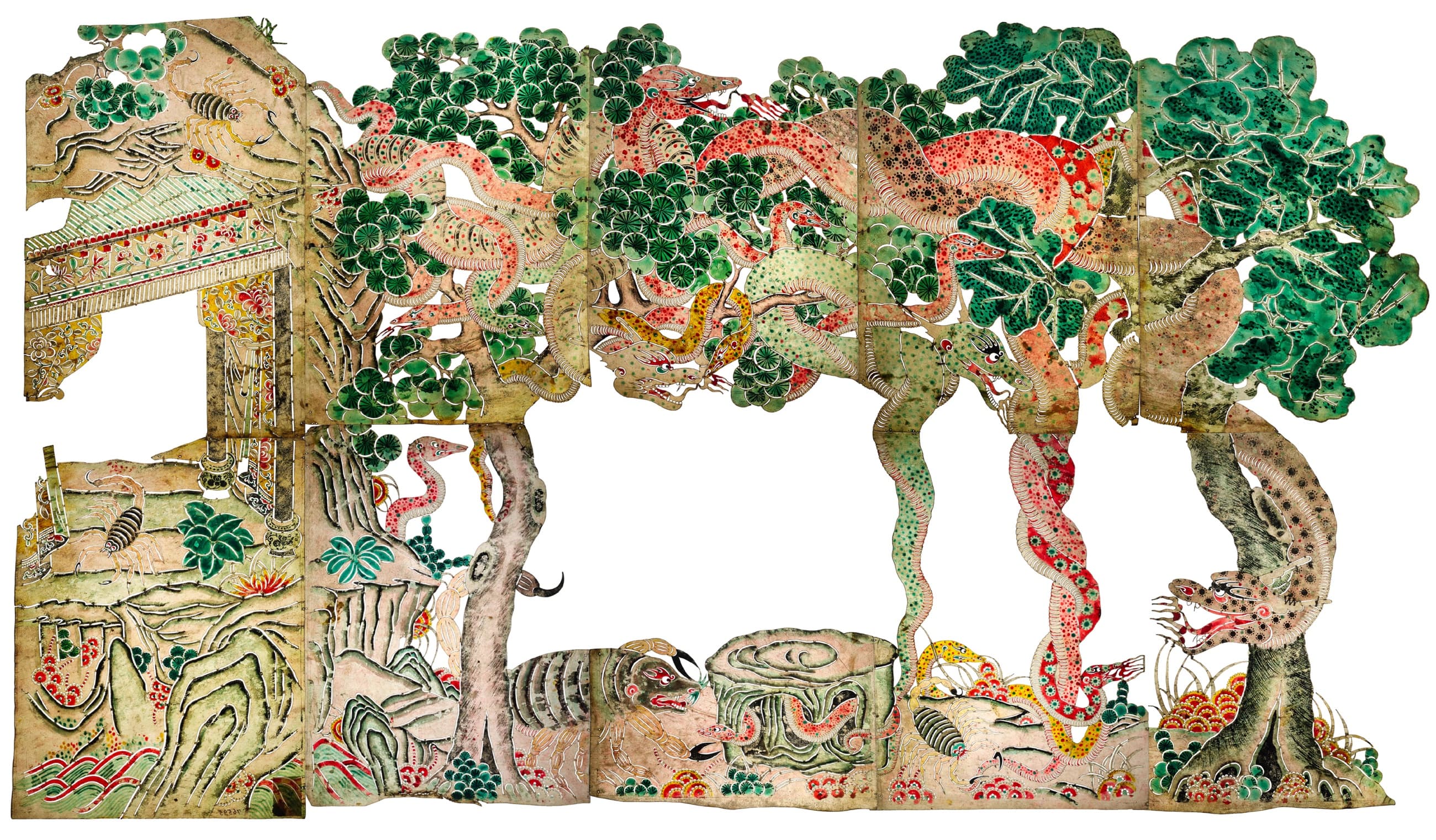
The repertoire of Chinese shadow theatre has drawn on historical tales, opera narratives, local legends and religious stories. In a Shaanxi collection, figures associated with Emperor Minghuang and Yang Guifei point toward one kind of courtly drama; another ensemble depicts Mulian's descent into the underworld to save his mother. These objects are displayed far from their original performance settings, and captions should not pretend we can reconstruct a particular evening from the surviving pieces alone.
The titles show the range a small troupe could summon. A court, a journey and a supernatural realm require no massive built stage. They are assembled from characters, backdrops, words, music and the audience's readiness to cross the screen's thin boundary.
The Screen Is Never Silent
Photographs naturally favour the carved figure, but the art is not a sequence of still images. Performers provide speech and song; instrumental accompaniment can announce entrances, alter pace and heighten a fight or lament. Light gives the figures visibility. Sound gives them social presence.
This is why a shadow puppet photographed against a neutral museum wall can be misleading if offered as the entire experience. It reveals the care of the maker, and that is valuable. It cannot reveal the quick exchange between puppeteers, singers and musicians, or the audience's response. To understand the craft, one must place the object back into a timed performance, even if the actual historical performance has not survived.
Look at the Gaps
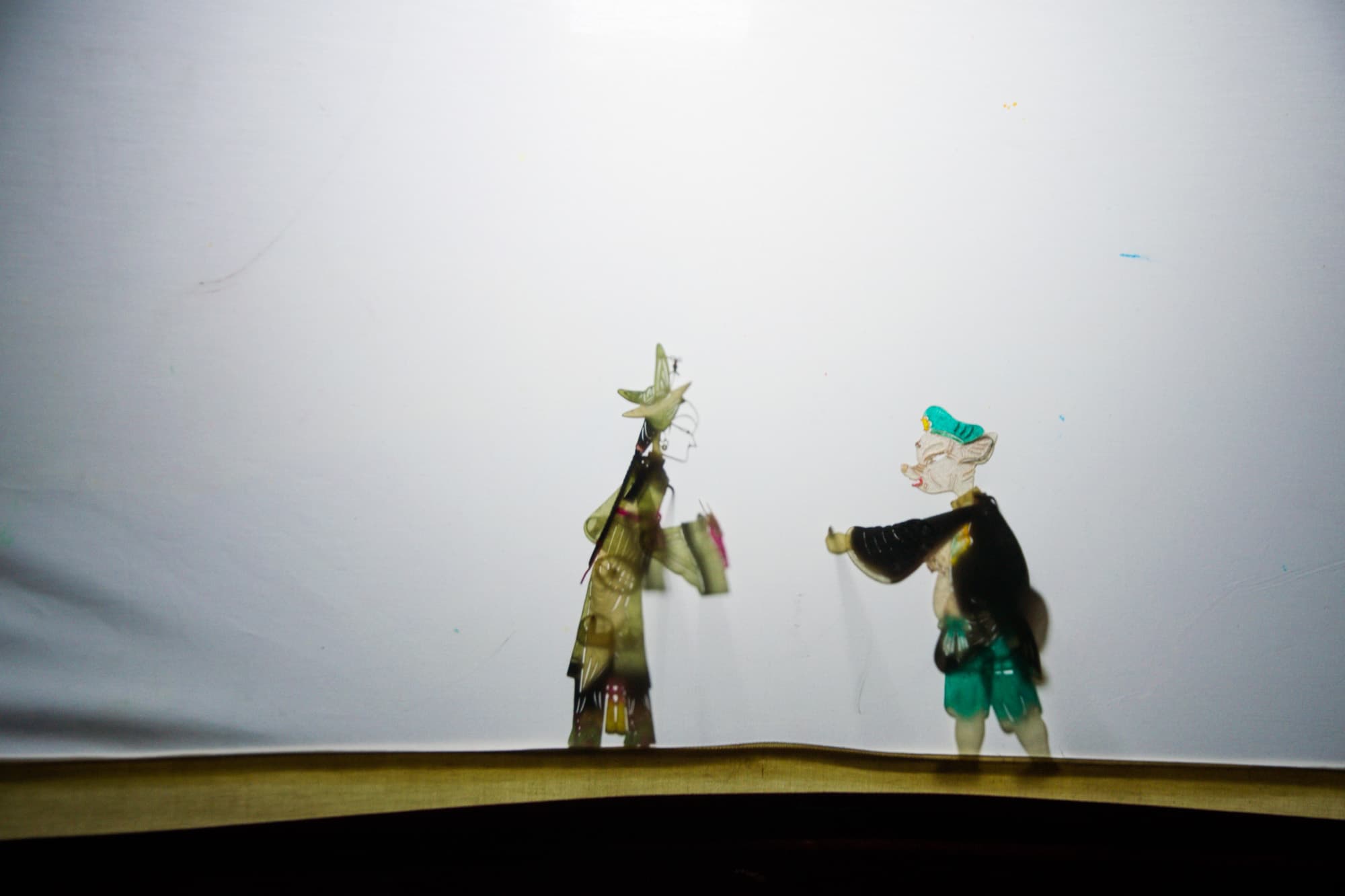
The spaces cut out of a puppet matter as much as the parts that remain. They allow light to draw a costume, face or gesture through the material. From behind a screen, the maker's negative space becomes the audience's visible line.
This exhibit detail should be read as evidence of a figure's craft, not evidence of a particular date, performer or show's sequence. The technique is intimate. Small cuts made near a worktable are intended to be read at the distance between a screen and an audience.
Image: Mitch Altman / Wikimedia Commons, CC BY-SA 2.0; resized for web.
An Old Art with Unsettled Beginnings
Shadow puppetry is often introduced with a neat ancient origin story. Such stories can be memorable, but the exact moment of invention is not established simply because a legend is old. UNESCO's recognition concerns a living practice and its transmission. That is a stronger foundation for a visitor than declaring a single founding performance whose date cannot be verified.
Practitioners learn not only to move puppets but to maintain figures, remember stories, coordinate voices and music, and adapt a performance to the occasion. Transmission is labour. A tradition survives because people choose to keep rehearsing it, teaching it and making room for it, not because it can be assigned a dramatic first year.
A World Made Portable
The title's leather box is an image of portability, not a claim that every troupe's entire stage fits into one measured container. The theatre needs equipment, people, instruments and a screen. Still, its imaginative economy is real. A group can carry characters and scenery that suggest worlds much larger than the room in which they perform.
For travellers, the best encounter is therefore not merely shopping for a carved souvenir. Watch a performance if one is available. Notice the change between object and shadow, between the hand controlling a rod and the figure suddenly appearing to decide for itself. If a museum is the only available setting, use it to learn how much work lies in a single joint.
The Bright Side of the Screen
A puppet held without light is a crafted object. A puppet behind a screen is a participant in a story. Neither state is more authentic; both are necessary. The maker designs for the performer, the performer depends on the maker, and the audience completes the transformation by seeing more than leather and rods.
When the lamp goes out, the court and the underworld vanish at once. The pieces remain, ready to travel, be repaired and appear again. Their smallness is not a limitation. It is the theatre's remarkable way of carrying possibility.