
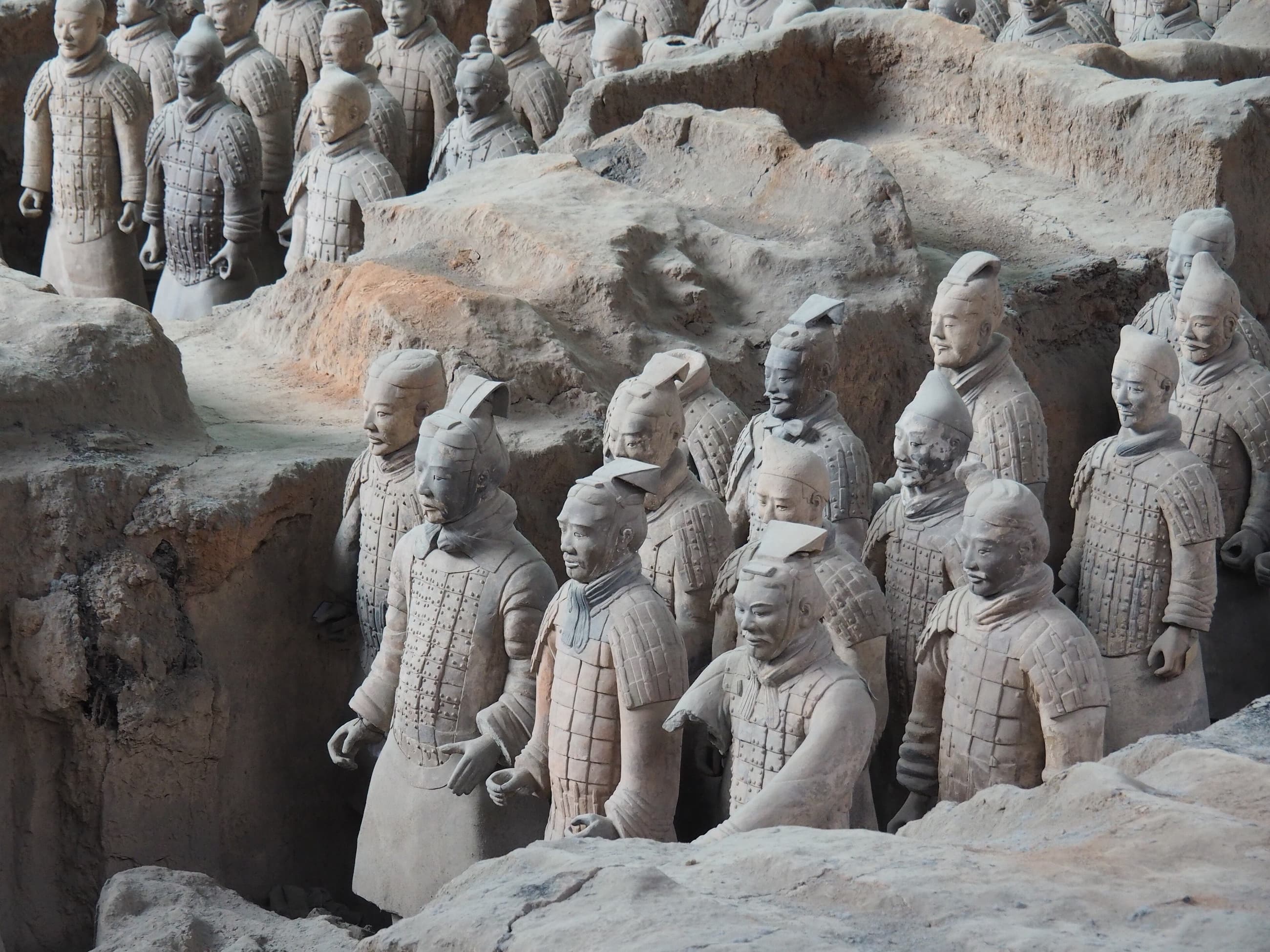
The first impression is almost monochrome: row after row of grey soldiers, their faces rising from brown earth beneath the great roof of Pit 1. Grey feels appropriately ancient. It makes the army look as though it has always belonged to dust.
But grey is not the army’s original colour. It is the colour of what survived after another surface was largely lost. The warriors were once lacquered and painted. Their robes carried reds, greens, blues, pinks and purples. Hair, armour, belts and shoes were differentiated. Surviving traces show that the underground formation was conceived not as an army of bare clay, but as a crowded field of colour.
That changes the central question. The wonder is not simply that clay figures remained underground for more than two millennia. It is that their most fragile evidence began to disappear precisely when the figures were brought back into the world.
A Well Into an Underground City
In March 1974, farmers digging a well near Xiyang village, east of the First Emperor’s burial mound, encountered fragments of terracotta figures and bronze objects. The discovery did not begin with a complete army standing in perfect formation. It began with broken pieces scattered through earth.
An archaeological team arrived that July. As trenches widened, the edges of the deposit kept retreating. Pit 1 proved to be about 230 metres long and 62 metres wide. Its corridors had once been roofed in timber, and researchers estimated that this pit alone had held roughly 6,000 warriors and horses. The number is an archaeological estimate, not a final inventory.
Even this enormous space is only one part of the mausoleum landscape. The famous army stands east of the still-unexcavated central tomb within a much larger imperial project.
Faces Without Names
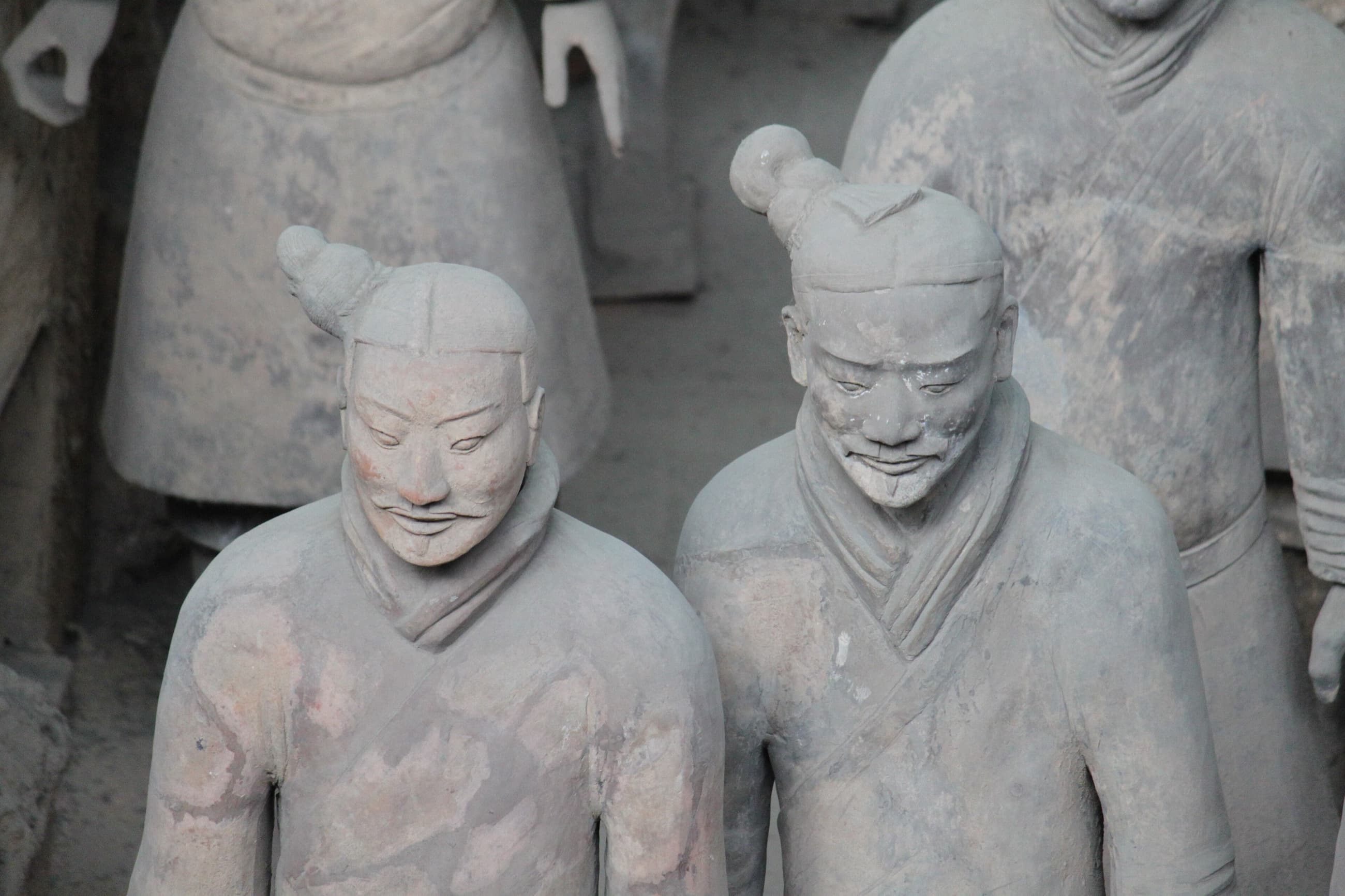
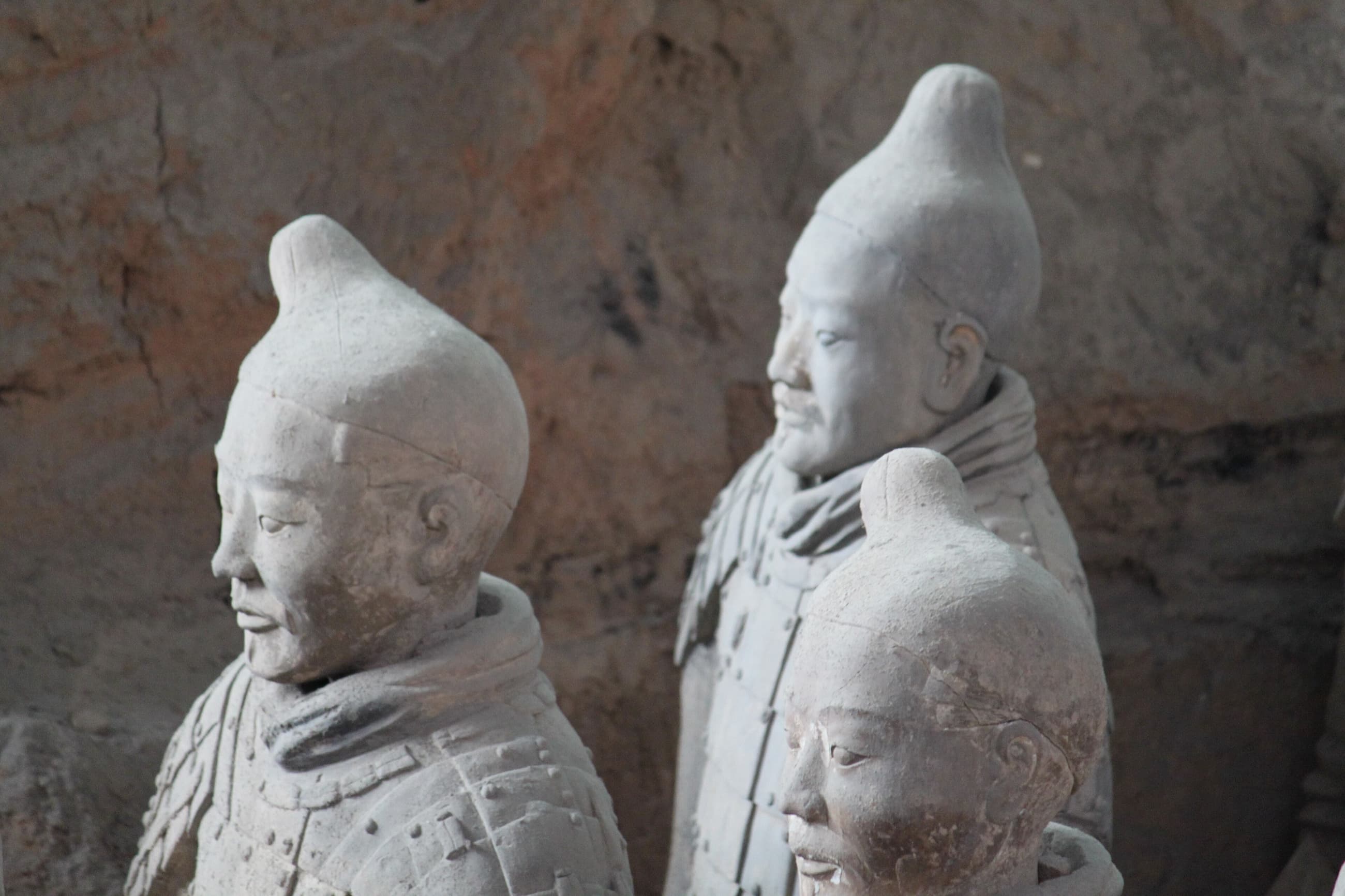
At a distance, the formation reads as mass. Up close, faces, hair arrangements, moustaches, body shapes, armour and headgear differ. Rank could be signalled through armour and headdress rather than through one modern-style uniform.
It is tempting to say that every face is a portrait of a real soldier. The evidence does not allow that certainty. The figures are highly individualised, but individualisation is not the same thing as confirmed portraiture. Workshops operated within shared methods while producing an extraordinary range of human presence.
Colour completed that presence. Painted eyebrows and moustaches sharpened expressions. Garments could carry borders and patterns. Once those layers disappeared, the sculpted form remained, but part of the information that separated one body from another went with them.
Image: face and headdress detail. Gary Lee Todd, Ph.D. / Wikimedia Commons, CC0; resized for web.
The Archer Who Kept His Paint
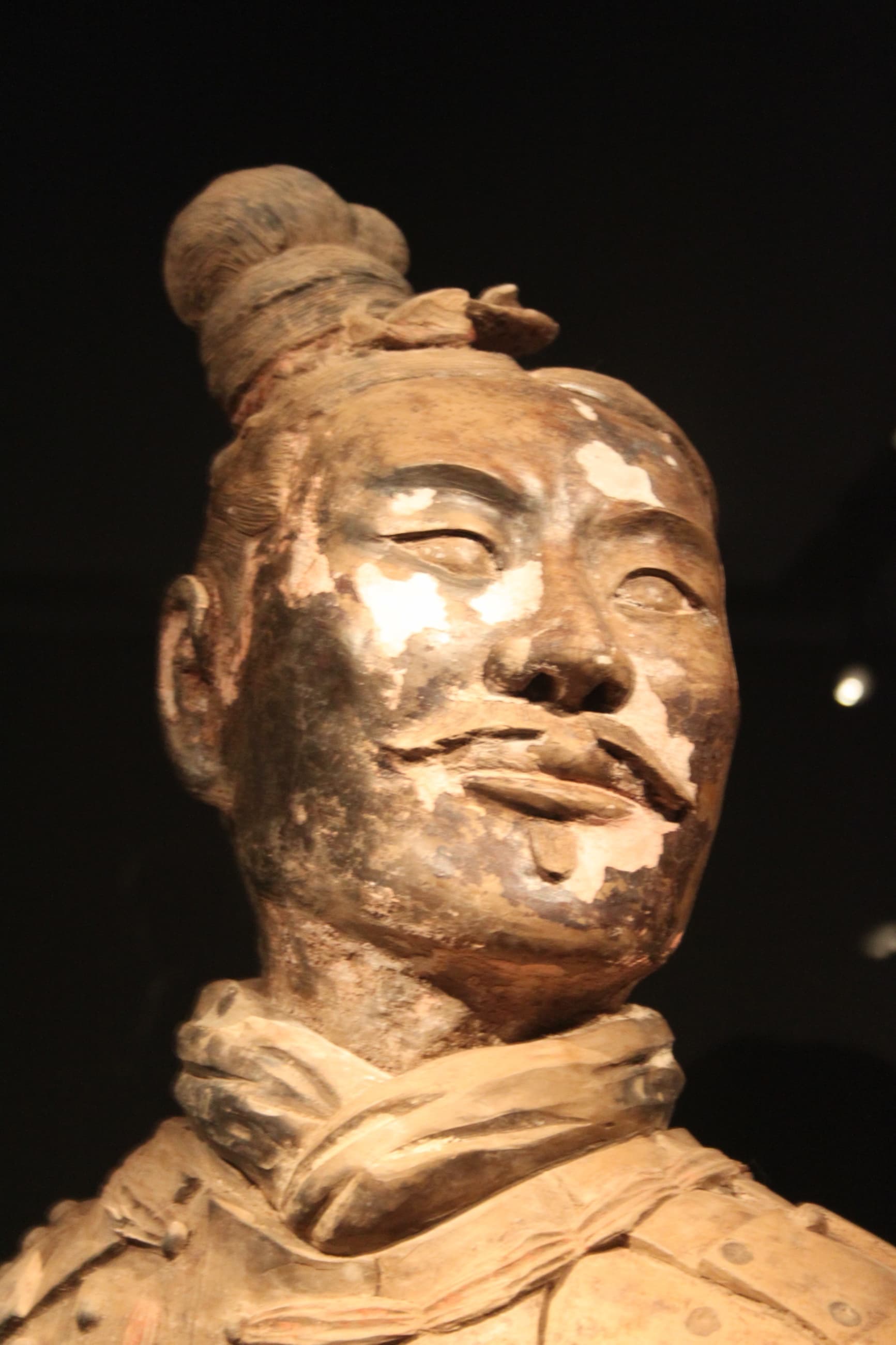
The painted surface was built in layers. Over fired terracotta, artisans applied qi lacquer made from the sap of the East Asian lacquer tree. Pigment was then placed above this dark, smooth ground. Scientific analysis has identified colours including malachite green, azurite blue, vermilion, iron-oxide reds and yellows, lead white, bone black and the technically demanding synthetic pigment often called Han purple.
These materials were not arranged according to one rigid palette. Research on surviving fragments has found varied combinations, patterned borders and details that follow the folds and movement of clothing. Colour did not merely brighten the army. It clarified textiles, ranks and bodies.
Information at Ground Level
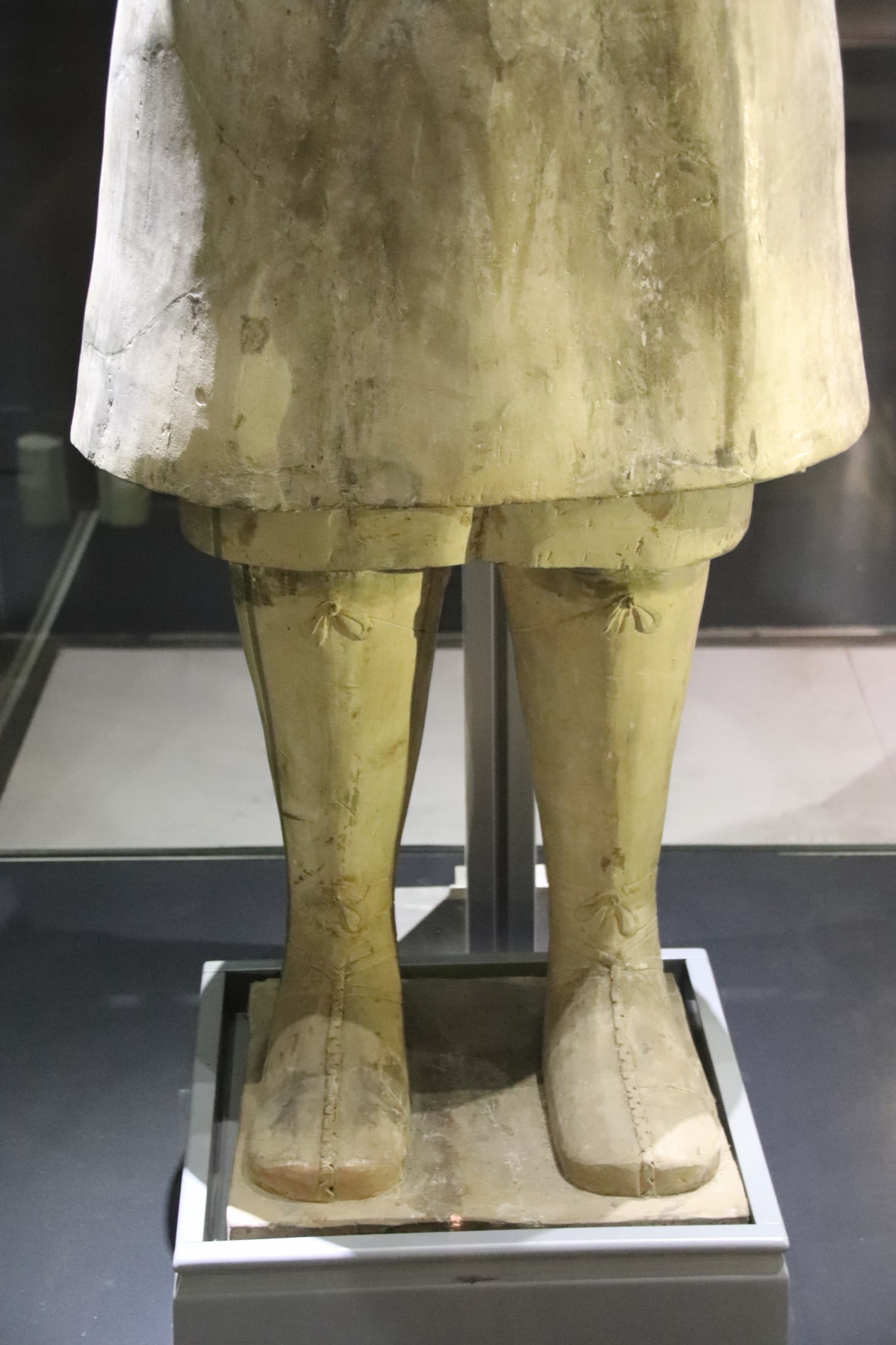
A pair of boots may seem minor beside an imperial army. In conservation, small protected surfaces can carry large amounts of evidence. A crevice, hem or armour edge may retain traces that exposed areas lost.
Researchers work from those fragments rather than from fantasy. A tiny patch can be examined under magnification, its layers recorded and pigments identified. Similar traces can suggest recurring techniques; differences warn against turning one discovery into a universal rule.
Pit 1 impresses through scale. A boot, ribbon or line of paint explains how that scale was made human.
Image: boots and garment modelling. Gary Todd / Wikimedia Commons, CC0; resized for web.
The Most Dangerous Moment
For centuries, damp soil held water inside the lacquer layer. Excavation changed that environment. In drier air, moisture leaves the lacquer; the layer can shrink, crack and curl away from the terracotta, carrying the pigment above it. Getty conservation research describes excavated pieces being kept in a saturated atmosphere before treatment because detached, brittle flakes are extremely difficult to secure again.
This process is often retold as colour vanishing ‘instantly’. The drama is real, but the phrase is too simple. Rates vary with an object and its environment. What matters is that damaging change can begin very quickly, and that an excavator cannot pause the atmosphere while deciding what to do.
The paradox is severe: uncovering a painted figure makes it available to knowledge and puts its surface at risk. Discovery is an environmental event.
Why Archaeology Sometimes Waits
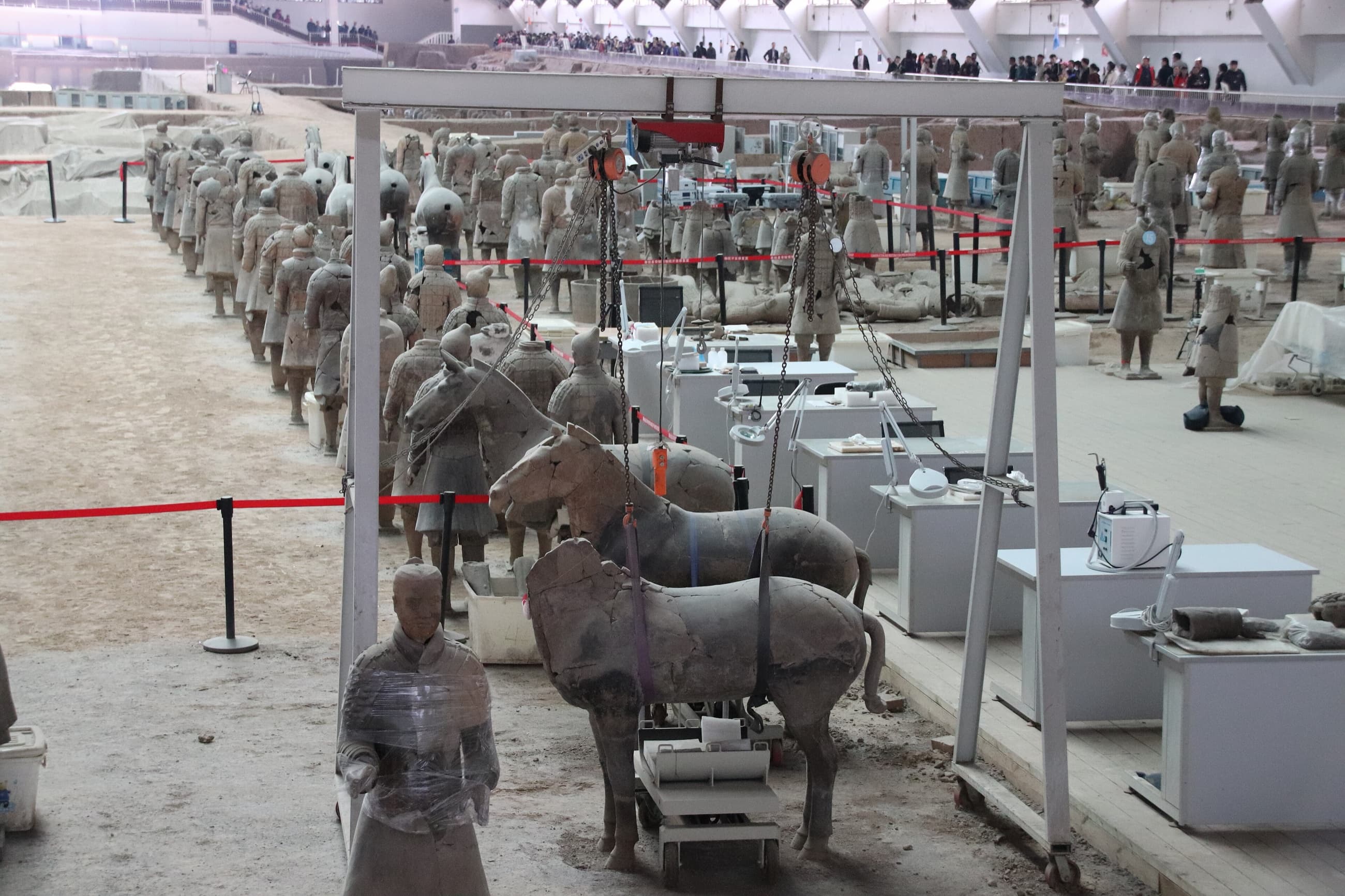
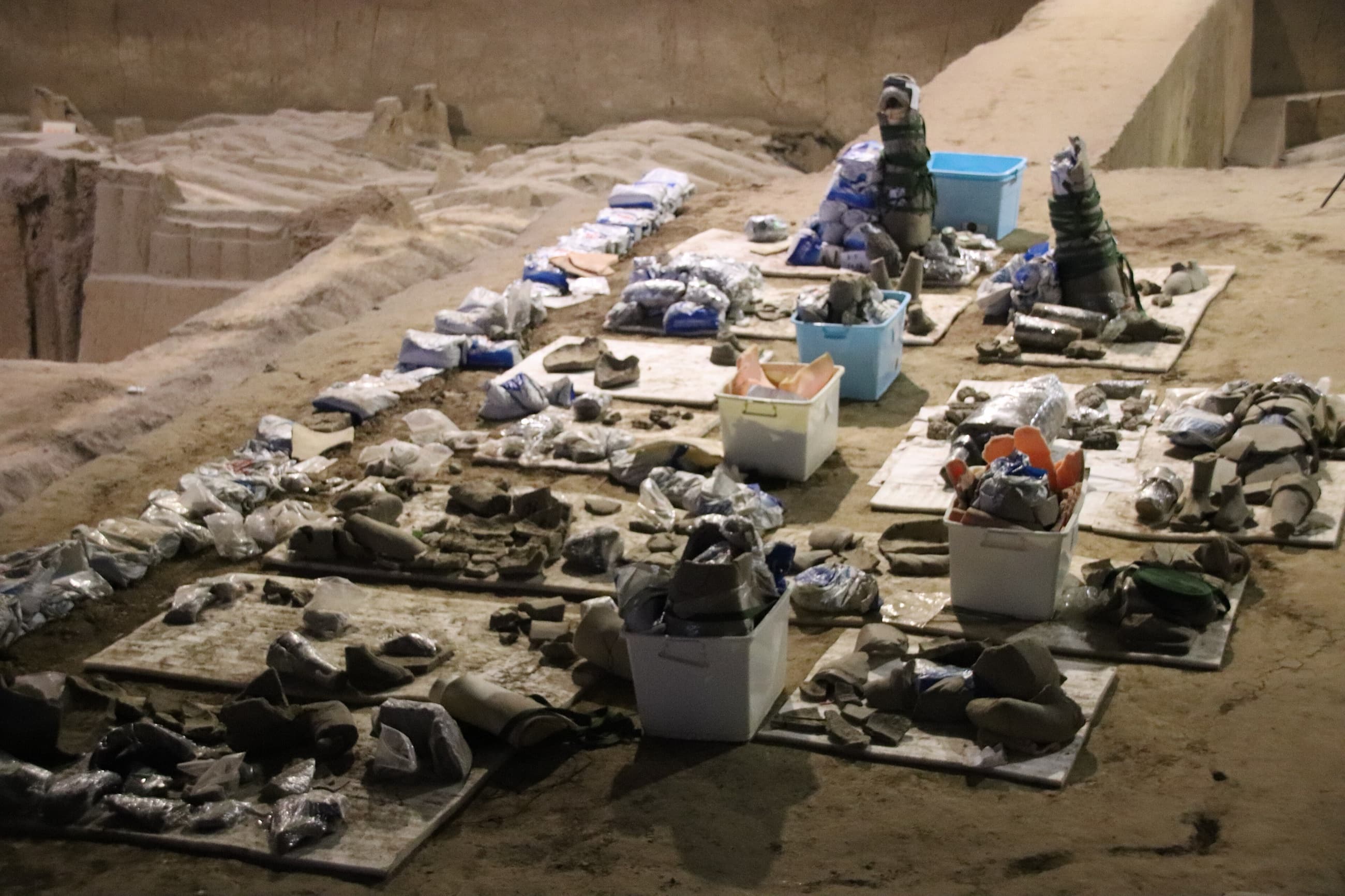
Chinese and German specialists spent years studying the paint structure, testing consolidants and developing ways to slow shrinkage and strengthen fragile layers. Treatment has included maintaining high humidity immediately after exposure and applying stabilising materials on site. Each method has trade-offs; there is no single liquid that restores every lost colour.
This is one reason excavation proceeds deliberately. Pit 2 is not an unfinished Pit 1 waiting for someone to work faster. Leaving material in a stable burial environment can preserve evidence until methods improve. The apparent emptiness of an unexcavated area may be an active conservation decision.
Visitors naturally want to see more. Archaeology has to ask a harder question: what must remain unseen today so that it can still be understood tomorrow?
Colour Begins as Material
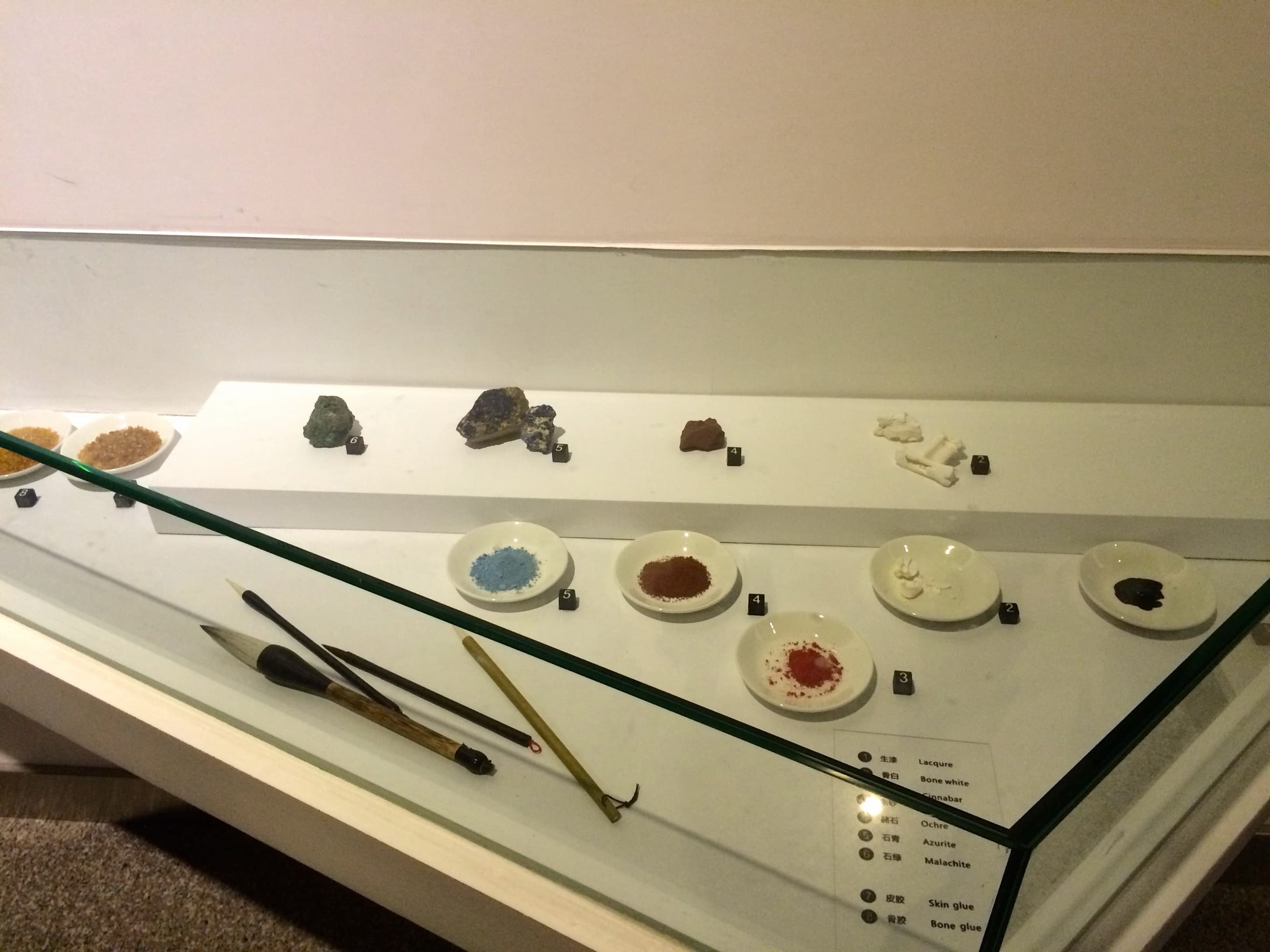
Modern colour reconstructions begin with physical evidence: surviving particles, paint layers and the minerals and binders identified through analysis. This display brings several of those materials back to human scale — powders, stones and brushes rather than a digitally completed army.
A palette does not reconstruct a uniform by itself. Researchers still have to decide how fragmentary colours related to garments, armour and figure types. Every completed image is therefore an argument assembled from evidence, not a recovered portrait of the pits.
Conservators do not repaint the originals to make them look whole. Doing so would replace surviving traces with a modern decision and blur the line between what is known, inferred and missing. The army now exists in three overlapping forms: the imperial project created in the third century BCE; excavated fragments visible today; and changing reconstructions produced by research. None fully substitutes for the others.
Once you know this, the grey is no longer empty. It records burial, exposure, loss and care.
Image: pigments and tools associated with the warriors’ polychrome surfaces. Charlie / Wikimedia Commons, CC BY-SA 4.0; resized for web.